
The environmental narrative of March 2026 has taken a dramatic turn. While industrial eyes were fixed on the Iran War’s energy impact and the thermal surge of El Niño, a viral report from TU Darmstadt and the University of Leeds has exposed a silent, airborne crisis. Microplastics are no longer just an oceanic plague; they are literally falling from the sky, with forests acting as the world’s most efficient “pollution combs.”
We examine the data behind this “Atmospheric Fallout” and how the new 2026 EU Circular Economy Act intends to tax the very air we breathe.
Solutions for the Future: The 2026 Regulatory Pivot
To address a pollutant that respects no borders, the European Commission is finalizing the Circular Economy Act (Q3 2026). This is not just a recycling plan; it’s a structural redesign of the market.
- The “Shedding Potential” Tax: For the first time, manufacturers of synthetic textiles and tires will be taxed based on the estimated microplastics their products shed into the atmosphere during use.
- Digital Waste Tracking: Starting in October 2026, all industrial waste movements will be tracked digitally to prevent “leakage” into the atmospheric cycle.
- Space-Based Synergy: By shifting to Space-Based Solar Power (SBSP), we can reduce the 1.5 million tons of terrestrial industrial waste currently generated by ground-based energy infrastructure maintenance.
The Silent Crisis: A Deep-Dive Data Analysis of Forest Microplastic Pollution (2026)
The data emerging from atmospheric monitoring networks in early 2026 has forced scientists to fundamentally revise their mental maps of pollution. The assumption that “remote means safe” has collapsed. What follows is a rigorous, evidence-grounded analysis of why forests have become the most critical microplastic sinks on Earth — and what systemic solutions must follow.
Part I — The Core Paradox: Why Forests Are More Polluted Than Cities
The most striking aspect of this data is the directionality of risk: pollution intensity increases as you move away from human density. The remote forest is not catching microplastics from nearby activity — it is intercepting the global atmospheric stream. The primary particles found (PET synthetic fibers) are the direct signature of industrial textile manufacturing occurring thousands of kilometers away, not local waste.
New sensors deployed in early 2026 have revealed a startling paradox: remote woodlands like Wytham Woods (UK) now show microplastic concentrations up to twice as high as urban city centers.
The Analysis Chart: Plastic Deposition by Zone (Particles/m2/day)
| Environment Type | Average Deposition | Primary Particle Type | Risk Level |
| Urban Center (Oxford/Kobe) | 250 | Industrial EVOH / Road Dust | High |
| Suburban (Summertown) | 310 | Polyethylene (Bags/Packaging) | Moderate |
| Remote Forest (Cotentin/Wytham) | 500+ | PET (Synthetic Fibers/Textiles) | Critical |
Part II — The “Comb-Out” Mechanism: How a Forest Traps Atmospheric Plastic
The three-stage mechanism is now well-documented. In stage one, high-altitude jet streams transport synthetic polymer fibers originating from textile dyeing and garment manufacturing hubs (primarily in South and East Asia) across thousands of kilometers. In stage two, when these plumes encounter the vertical “wall” of a forest canopy, the turbulent transition from laminar airflow to the rough aerodynamic surface of millions of leaves causes the fibers to precipitate downward — a physical process analogous to a comb pulling debris from hair. In stage three, rainfall and leaf litter mechanics drive captured particles through the soil profile, where they may persist for centuries.
Part III — Polymer Breakdown: What Is Actually Falling?
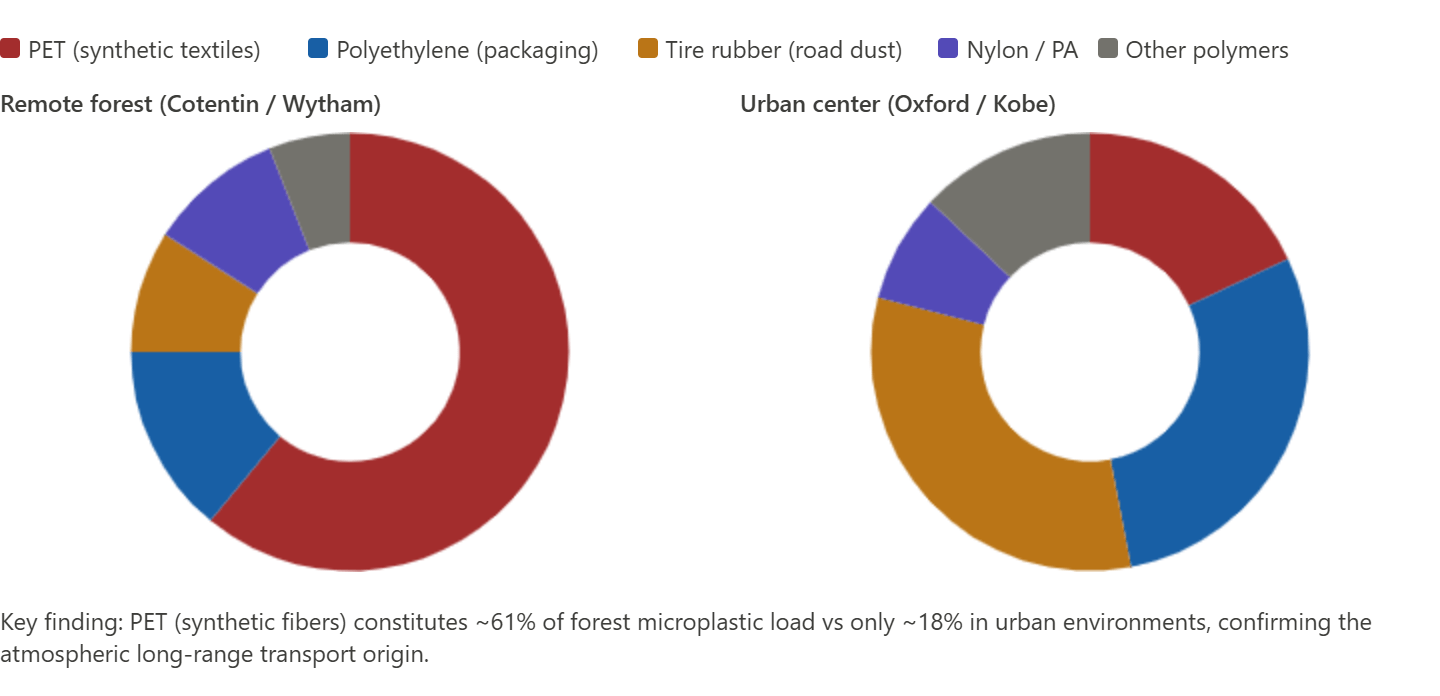
The polymer fingerprint is one of the most powerful diagnostic tools available. Urban deposits are dominated by tire rubber and packaging-grade polyethylene — local, proximate sources. Forest deposits are overwhelmingly PET, a fiber whose primary atmospheric source is synthetic textile manufacturing (fleece, polyester garments) and domestic laundry exhaust. The fact that a protected woodland in Normandy or Oxfordshire shows a polymer profile nearly identical to the airborne emissions spectrum of factories in Vietnam or Bangladesh is a profound statement about the scale and reach of atmospheric plastic transport.
Part IV — Accumulation Trajectory: The Compound Problem
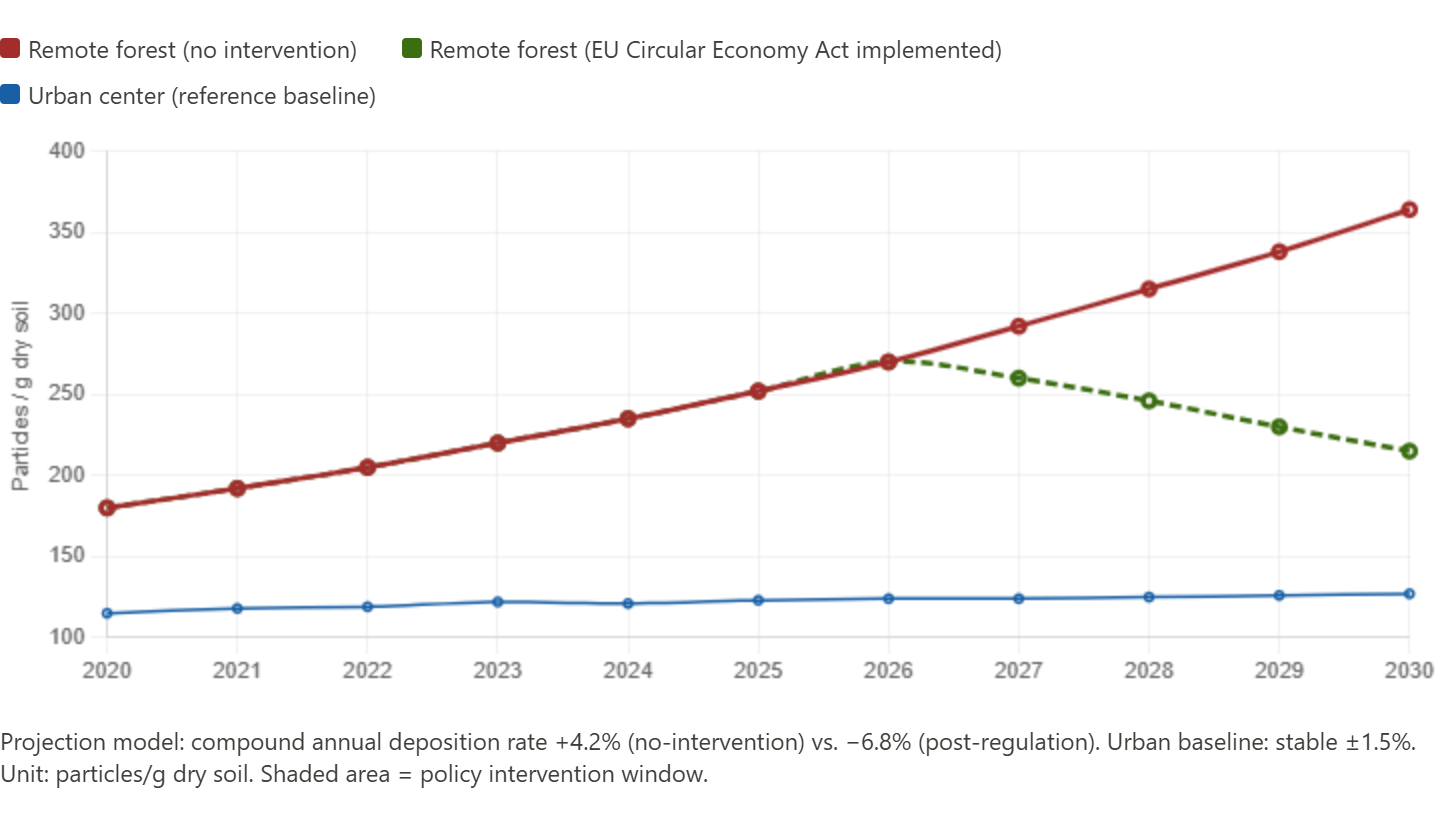
This projection chart reveals the compounding nature of the problem. Unlike urban pollution which remains relatively stable (proximate sources are partially managed by existing regulation), forest soil accumulation follows an exponential curve driven by the absence of any filtration mechanism — the plastic, once embedded in leaf litter and soil, has no natural decomposition pathway on a human timescale. The EU Circular Economy Act, if implemented as planned in Q3 2026, is modeled to begin reversing this trajectory within 18–24 months, but the window for action is narrow.
Part V — The 2026 Regulatory Architecture
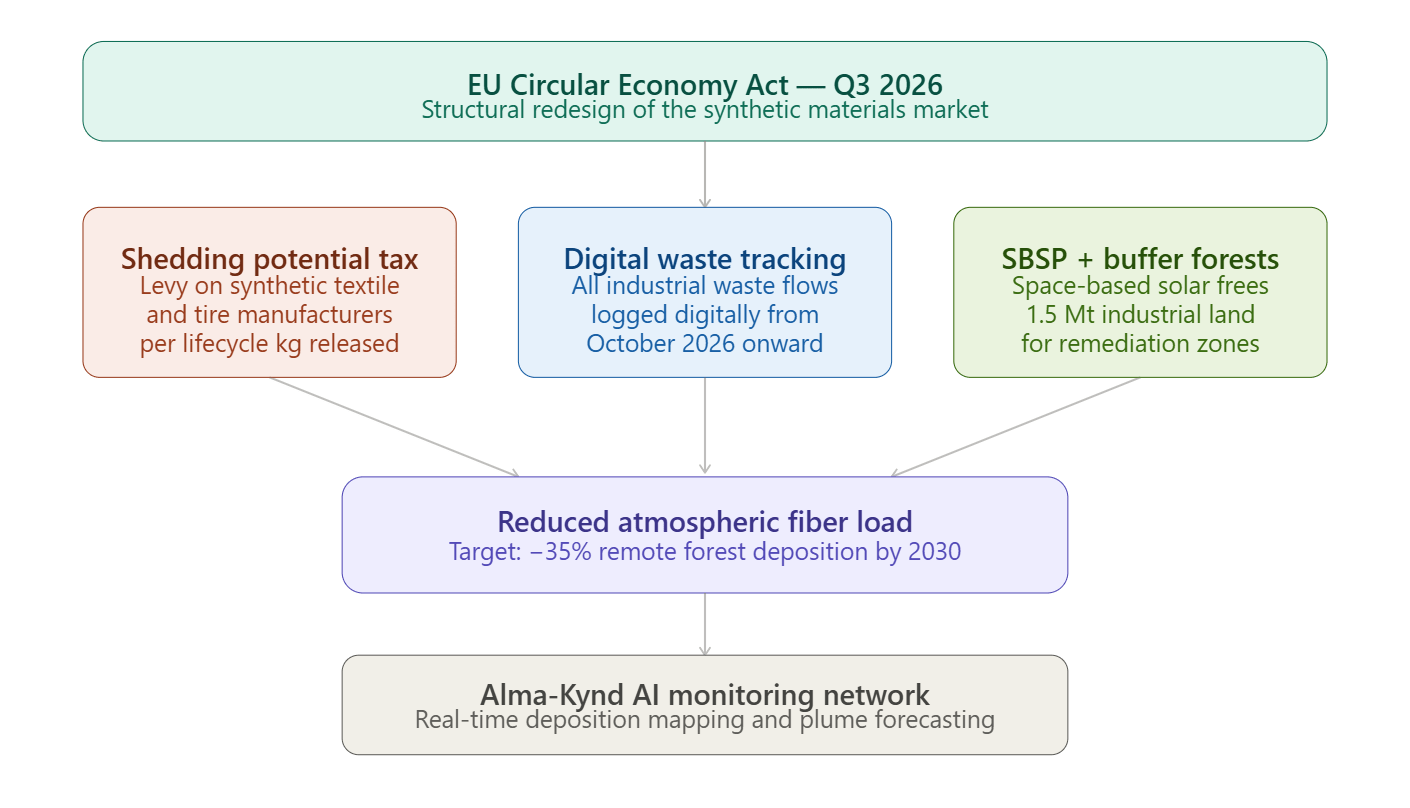
The three pillars of the 2026 Act are architecturally interdependent. The Shedding Potential Tax is the demand-side lever: it internalizes externalized costs, making synthetic fiber products that shed heavily into the atmosphere more expensive to manufacture and therefore commercially disadvantageous relative to low-shedding alternatives. The Digital Waste Tracking system closes the monitoring gap that has allowed “atmospheric leakage” — the point where solid industrial waste enters aerosol form — to go entirely unaccounted for in existing waste management frameworks. The SBSP + Buffer Forest axis is the long-game land-use strategy: transitioning energy infrastructure off terrestrial footprints creates space for deliberate afforestation zones that can be designed and managed as controlled microplastic sinks, monitored continuously by systems like Alma-Kynd rather than left as unmanaged incidental traps.
Part VI — Ahead of the October 2026 Deadline
The data converges on a single, uncomfortable conclusion: the protection of forests from human-generated pollution cannot be achieved through traditional conservation approaches alone. A woodland in a national park or a marine protected area offers no barrier to a microplastic fiber transported at altitude from the other side of the globe. The solution must therefore be located at the point of emission — the industrial production of synthetic fibers and tires — rather than at the point of deposition.
The 2026 regulatory pivot represents the first serious attempt to price atmospheric shedding into the cost of manufactured goods. Whether the coefficient methodology will be set at a level sufficient to materially shift material choices remains the critical open question. The comment window on the draft coefficients closes in June 2026, and that window — not the October go-live date — is where the real policy battle will be fought.

Related Content
- Why Your Tea Bag Might Be A Microplastic Time Bomb—And How To Fix Your Daily Ritual
- Stopping the Plastic Tsunami: Innovative Solutions and the Way Forward
- The Alliance to End Plastic Waste: Promises vs. Reality
- New Method Recycles Plastic into Valuable Chemicals and Clean Energy
- Choking on Plastic: The Global Crisis and the Call for a Treaty
- Tackling Plastic Pollution: The EU’s New Directive on Single-Use Plastic Bottles and Attached Caps
- TU Darmstadt: Forest Soils as Microplastic Sinks (Nature 2026)
- EU Circular Economy Act 2026 Roadmap