
From cracked riverbeds in Germany to silent beehives in Provence, this summer’s heat isn’t a headline happening somewhere else. It’s in your grocery bill, your garden, and your glass of water.
When the Planet Won’t Stop Sweating
You know that feeling when a fever just won’t break? The ache behind your eyes, the fog that won’t lift, the way even lifting a glass of water feels like a chore. Now stretch that feeling across an entire planet — and take away the part where it eventually breaks.
This summer didn’t just nudge past old temperature records. It obliterated them. Phoenix baked at 50°C, hot enough that asphalt turns soft underfoot. Spanish sidewalks became griddles. Over France and Central Europe, a heat dome parked itself in the sky and simply refused to leave.
But the real story isn’t the sweat-soaked commute or the air conditioner working overtime. It’s quieter than that, and it’s happening underground and underwater — in the rivers that have kept Europe alive for two thousand years, and in the tiny, furious wingbeats of a bee trying to keep her babies from cooking.
1. The Rivers That Built Civilizations Are Running Out of Breath
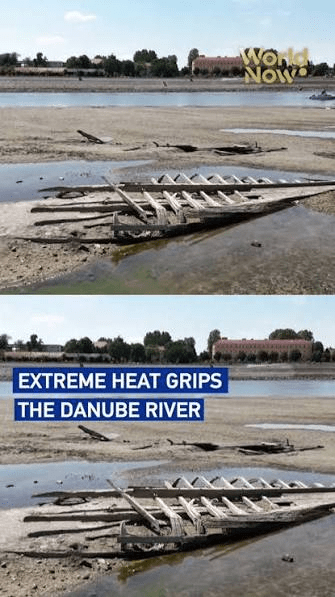
Picture the Rhine. Romans floated wine barrels down it. Medieval traders moved spices along its banks. Today it still carries roughly 200,000 barges a year — grain, coal, the chemicals that keep half of Europe’s factories running.
This summer, near the town of Boppard, the water dropped low enough that captains could see the riverbed beneath their hulls. Barges built to haul 2,000 tons were suddenly limited to 500 — like your delivery truck making four trips instead of one, except somebody has to pay for those extra trips. That somebody is you, in the form of higher prices and slower shelves.
The Rhine isn’t struggling alone. Along the Danube, water levels have dropped so far that Hungarian officials are watching nervously — not just for shipping, but because nuclear plants pull river water to cool their reactors. When the river runs too warm or too shallow, the plants throttle back. Imagine your power flickering in the middle of a 40°C afternoon because the river itself can no longer do its job.
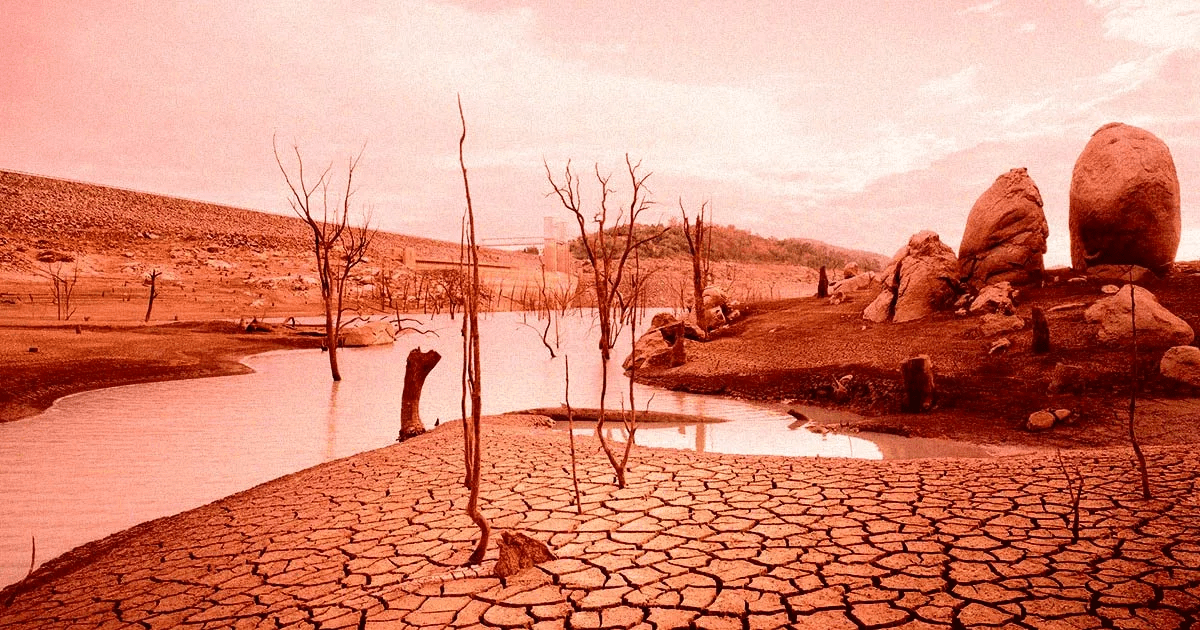
Meanwhile in France, the Rhône and the Loire have triggered emergency restrictions. Farmers watch their fields go unwatered. Fish gasp in water that now feels closer to bathwater than a living stream. A shallow river heats up fast, and warm water holds less oxygen — it escapes the same way bubbles rush out of a shaken soda. Fish suffocate. Insects vanish. Everything downstream inherits the damage.
2. The Collapse You Can’t See: Silent Hives, Sweatless Trees
This is where the story stops being abstract.
The Bee Fanning Herself to Exhaustion
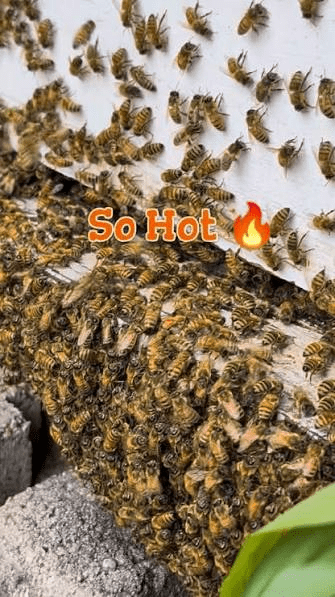
Picture a single honeybee on a scorching July afternoon. Her hive needs to hold steady at 34°C — nursery temperature for the next generation. When the outside air climbs past 40°C, she has one decision to make: fly out and forage, or stay home and become a living fan.
She stays. So does every bee she works alongside. The whole colony turns into a cooling system, wings blurring, trying to keep the brood from cooking alive. Nobody forages. Your almond trees go unpollinated. Your apple blossoms sit untouched.
It gets worse for the bees working alone. Solitary bees don’t have sisters to help them cool down — they’re on their own, and the heat finds them anyway. Researchers have found that when developing males experience temperatures around 38°C, their sperm counts can drop by roughly 30%. That kind of damage doesn’t show up as dead bees on the ground. It shows up quietly, a year or two later, as populations that simply stop rebuilding.
A beekeeper in southern France put it to me plainly: some seasons he’d pull 80 kilos of honey from a single hive. This year, 20 kilos felt like a win. His bees weren’t lazy. They were just trying to stay alive.
Trees Sweat Too — Until They Can’t Afford To
Trees cool themselves the same basic way we do: they release water vapor through their leaves, a process called transpiration. But when the ground is bone-dry, that water becomes too precious to spend. So the tree does something almost defensive — it seals its leaf pores shut, cutting off the loss.
The problem is those same pores are how the tree breathes in the carbon dioxide it needs for photosynthesis. Seal them shut and the sugar factory grinds to a halt. No sugar, no nectar. The flowers might still look picture-perfect, but they’re empty promises — beautiful and nutritionally hollow.
Then there’s the cruelest trick of all: heat pushes blooming earlier. A cherry tree might flower two weeks ahead of schedule, while its bees are still waking up from winter dormancy. By the time the bees emerge, the party’s already over — a mismatch scientists call phenological decoupling, which is a clinical way of saying nature’s calendar and its pollinators have quietly stopped talking to each other.
Even when the timing lines up, heat degrades the proteins inside pollen, turning it into something closer to stale bread than nourishment. Fruit fails to set. Almonds drop before they mature. And that’s roughly the moment you find yourself staring at a $15 bag of almonds in the grocery store, wondering what happened.
3. A Normal Summer vs. This One
| What’s Affected | A Healthy Summer | This Summer’s Heatwave |
|---|---|---|
| Rhine & Danube water levels | Barges run at full capacity | Loads cut by up to 75%; nuclear plants on alert |
| River temperature | Cool enough for fish and insect life | Warm enough to kill trout, starve the water of oxygen |
| Honeybee colonies | Out foraging, building honey stores | Fanning nonstop just to keep the hive alive |
| Solitary bees | Stable, healthy reproduction | Heat-damaged fertility, shrinking populations |
| Tree nectar output | Steady all season | Near zero; blooms arrive early and empty |
| Your grocery bill | Predictable | Climbing — especially almonds, apples, anything pollinator-dependent |
So What Do We Actually Do About It?
Here’s the part that isn’t hopeless. We’re not starting from zero — we already know several things that work. This isn’t about a reusable water bottle and a clear conscience. It’s about rethinking how we manage water, land, and farms at a structural level.
Stop treating rivers like drainage pipes. For decades, engineers straightened rivers and lined them with concrete to rush floodwater away from farmland — the equivalent of sending your shower water straight to the sewer instead of letting your garden soak it up. Give rivers their curves back, reconnect them to their floodplains, and the land becomes a sponge: soaking up water in wet months, releasing it slowly through the dry ones. The Netherlands has already committed to this shift — trading higher dikes for room for rivers to spread — and it’s paying off in fewer drought and flood disasters.
Turn farms into shaded, layered ecosystems. Agroforestry means planting tall, drought-hardy trees — carob, mulberry — in rows across farmland, with crops growing in the shade beneath. That canopy can drop ground temperature by 3 to 5 degrees, which is often the exact difference between a bee that can forage and one stuck fanning her hive all day. On a Portuguese farm I visited, olive trees grow under a canopy of cork oaks; even mid-heatwave, the shaded soil stays cool enough for wildflowers, and the bees keep producing honey all summer. The unshaded farm next door looks like a dust bowl by comparison.
Rethink where and how we keep bees. Thin wooden hives act like solar ovens. Switching to insulated, reflective materials — thick walls, pale colors — placed in dappled shade near water sources makes a real difference. Adding a shallow water station with gravel or floating corks lets bees drink without drowning. It’s a small fix almost anyone can make.
What You Can Actually Do This Week
No lectures about giving up your car or going vegan overnight — just four things that genuinely help:
- Set up a bee water station. A shallow bowl, some pebbles or old wine corks so bees don’t drown, placed in the shade. Refill it daily during a heatwave. Ten minutes, real impact.
- Cut back on water during peak drought. Shorter showers, fixed leaks, garden watering only at dawn or dusk. Every liter saved takes pressure off rivers and groundwater.
- Plant flowers that bloom late and tolerate drought. Lavender, rosemary, salvia, carob — they flower right when the heat has shut everything else down, giving pollinators something to eat when nothing else is available.
- Let your lawn grow out. Taller grass shades and cools the soil beneath it, holding onto moisture. It looks less tidy. It also becomes a microclimate that insects can actually survive in.
Watch and Learn More
For a closer look at Europe’s river basins, the farming innovations trying to outpace the heat, and the biodiversity rescue efforts underway: How Europe’s Rivers Are Drying Up and What Can Be Done.
Final Thought
This isn’t a warning about some distant future. It’s happening right now — in the rivers that supply our cities, the bees pollinating our food, and the trees meant to be cooling our landscapes. The encouraging part is that we already understand the mechanics of the problem, and we already know several fixes that work. None of it is quick. None of it is easy. But if it starts in our gardens, our farms, and our rivers, it starts somewhere real.
And maybe, with enough of these small shifts stacked together, we get back to a world where bees can forage in peace, rivers run free again, and your summer salad doesn’t come with a shocking price tag.
Related Content
- Extreme drought-heatwave events threaten the biodiversity and stability of aquatic plankton communities in the Yangtze River ecosystems | Communications Earth & Environment
- Geneva’s Homes to Be Heated by Recycled Energy from Revolutionary Swiss Data Centre
- 30 Days of Heatwave Per Year, Up to 50°C Feared: Why Île-de-France Could Become a Hell in Summer by 2050
- Earth Ends 13-Month Streak of Record Heat: What Comes Next?
- 2024: A Year of Unprecedented Heat
- Antarctica on Fire: Record-Breaking Heat Wave
- Cool Roofs Are Best at Beating Cities’ Heat
- Planet on the Brink: UN Report Warns of Record-Breaking Heat and Climate Chaos
- Introduction: Understanding the Resilience of Kelp Forests During the 2014-2016 Pacific Marine Heatwave
- Unprecedented Ocean Heating Raises Alarming Concerns: A Glimpse into a World 3.0°C Warmer
- Unprecedented Ocean Heating and Climate Shifts: A Call to Action for Eco-Friendly Sustainability
- Corfu Travel Guide 2026: 4 Secrets to Sustainable Tourism
- 4 Revolutionary Ways European Schools are Saving the Planet Today