
The landscape of education in Europe is undergoing a profound green metamorphosis. Beyond the traditional curriculum of mathematics and literature, schools and universities are becoming living laboratories for sustainability. This evolution is driven by the realization that educational institutions are not just places of learning, but powerful agents of ecological restoration and community resilience. From the Alpine foothills of Haute-Savoie to the digital classrooms of British vocational education, a new generation of students is being shaped not only to understand the environmental crisis, but to lead the response to it.
1. The E3D Framework: Excellence in Action
In France, the E3D certification (Établissement en Démarche de Développement Durable) serves as a gold standard for schools integrating sustainability into their very DNA. Administered under the auspices of the French Ministry of National Education, the label recognizes schools that demonstrate a whole-institution commitment to sustainable development — one that goes far beyond a recycling bin in the corridor.
To earn the E3D label, a school must show that sustainability is embedded across three interrelated dimensions: educational practices, operational management, and community partnerships. Assessors look for evidence of student participation in governance, measurable reductions in energy and waste, and concrete links between the school and its local ecological and social environment. The label is not granted permanently; schools must renew their commitment through ongoing action and evaluation.
Schools that achieve E3D certification demonstrate how the transition works through a holistic approach:
- Student-Led Governance: Students act as “Eco-delegates,” proposing and managing projects ranging from waste reduction to energy conservation.
- Operational Integration: Sustainability isn’t just taught; it is practiced through organic canteens, comprehensive recycling programs, and the creation of “green spaces” on campus for biodiversity.
- Community Synergy: These schools partner with local associations to promote useful products and tips in ecology, bridging the gap between the classroom and the local community.
The E3D framework reflects a broader European philosophical shift: sustainability can no longer be a single subject on a timetable. It must be the animating spirit of the entire educational project.
2A. A Case Study: La Présentation de Marie, Saint-Julien-en-Genevois
Nestled in the heart of Saint-Julien-en-Genevois — a dynamic cross-border town in the Haute-Savoie department, just minutes from Geneva — the Groupe Scolaire La Présentation de Marie stands as one of the most historically rooted and forward-thinking private Catholic schools in the French Alps.
A Rich History, A Living Mission
The school’s origins are deeply tied to Saint-Julien-en-Genevois itself: it was here, in 1833, that Marie Rivier — the founder of the Congregation of the Sisters of the Presentation of Mary — opened her first educational establishment. Nearly two centuries later, that founding spirit of openness, service, and community endures. The school’s guiding philosophy today is to “live according to an open gospel,” with relationships between families and the institution built on tolerance, open-mindedness, exchange, and sharing.
What has evolved dramatically is the scale and scope of the institution. The school now encompasses a nursery school (maternelle), a primary school (élémentaire), a collège, and a lycée — all located on the same site in the heart of the city, each with its own dedicated spaces and specificities, but united by a single educational community. The head of the institution, Martial Pouvrasseau, coordinates all levels with the ambition of forming what he describes as “a single educational community — like a large family.”
Sustainability at the Core of the Educational Project
La Présentation de Marie has embraced the E3D philosophy as an extension of its founding values. For a school whose Catholic heritage emphasizes stewardship of creation and responsibility toward future generations, environmental education is not a bureaucratic add-on — it is a natural expression of the school’s deepest commitments.
The school integrates sustainability across all levels of its operation. At the primary level, young pupils are introduced to concepts of biodiversity, waste reduction, and seasonal food through hands-on projects in the school’s green spaces. At the collège level, cross-disciplinary projects (EPI — Enseignements Pratiques Interdisciplinaires) connect ecology with other subjects in innovative ways. A particularly vivid example is the EPI partnership between life sciences (SVT) and visual arts: students from the third year (3e) visited the Geneva Botanical Gardens and the Museum of Art and History, connecting ecological knowledge with cultural and aesthetic reflection. This kind of synthesis — learning about plant biodiversity through the lens of visual art — exemplifies the holistic educational philosophy that E3D demands.
At the lycée level, students engage with more complex questions of environmental management, climate science, and sustainable development in a region that is acutely aware of ecological change. The Alps, after all, are one of the most climate-vulnerable regions in Europe, with retreating glaciers and changing snowfall patterns serving as visible, immediate evidence of global warming. For students in Saint-Julien-en-Genevois, sustainability is not an abstract global concern — it is visible from the classroom window.
A School as Community Hub
The location of La Présentation de Marie is itself significant. Saint-Julien-en-Genevois sits on the Franco-Swiss border, and the school community is genuinely bicultural, drawing students whose families work across the border in Geneva’s international institutions — including the United Nations Environment Programme (UNEP) and the WHO. This international dimension enriches classroom discussions about global ecological policy and gives sustainability education a cosmopolitan character rarely found in small French towns.
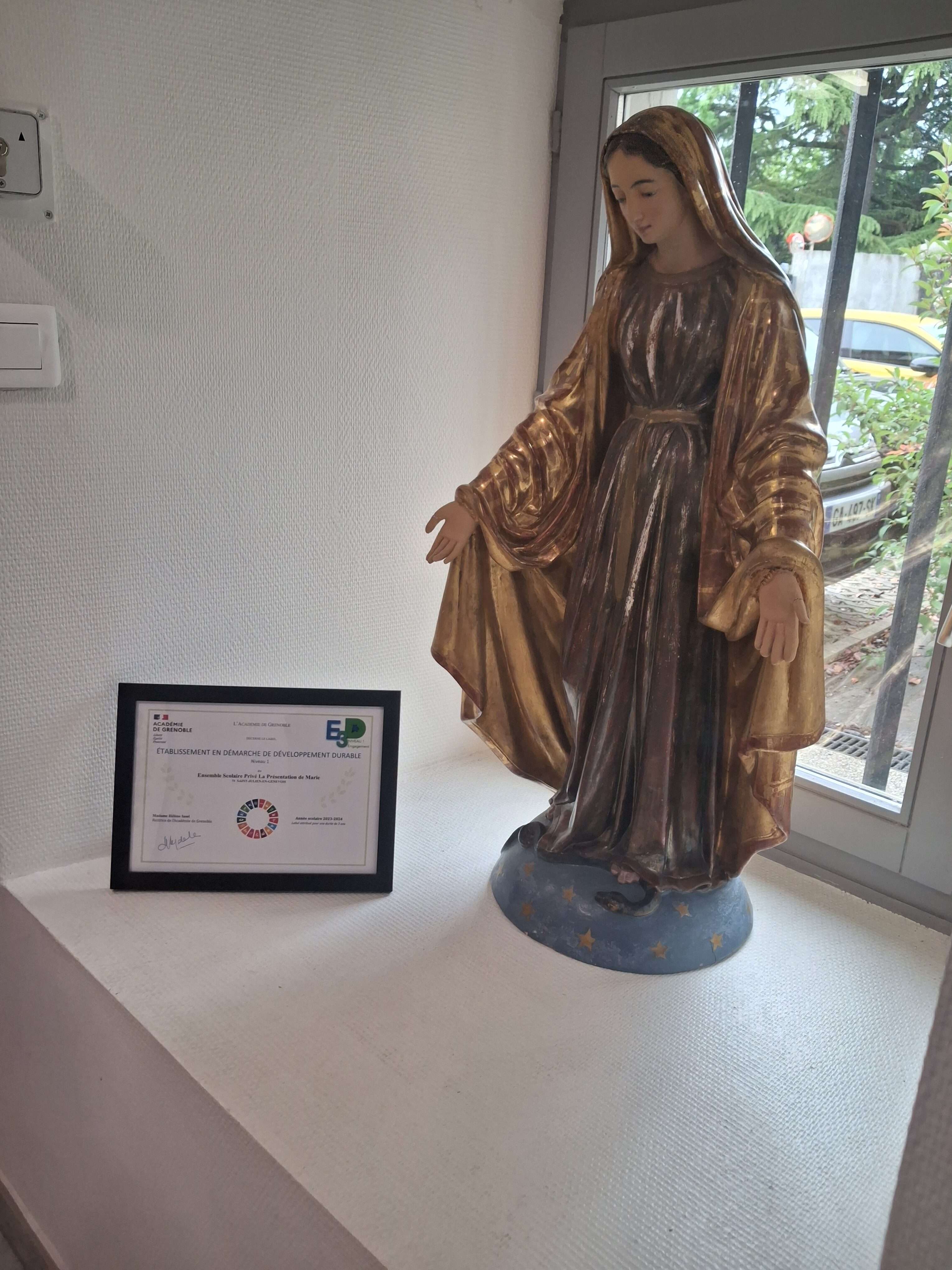
The school actively cultivates its role as a community hub. It collaborates with local associations, participates in municipal sustainability initiatives, and hosts events that bring together students, families, and the wider Saint-Julien community around ecological themes. This outward-facing approach — schools as agents of community change rather than islands of instruction — is central to the E3D vision, and La Présentation de Marie pursues it with particular energy.
The school’s mission is explicitly to prepare students to become “engaged, responsible, and competent leaders in a constantly evolving world” — a formulation that aligns naturally with the demands of sustainable citizenship. In the classrooms of Rue Monseigneur Paget, that ambition is not merely a motto; it is enacted daily through the choices students make about how to inhabit their shared space.
2B. École Schulz, Geneva: Digital Skills for a Sustainable Economy
As a complementary Swiss case study, the Ecole Schulz, also contributes to sustainability education through different but reinforcing pathways.
Situated in the heart of Geneva — a city that hosts the United Nations Environment Programme, the World Meteorological Organization, and dozens of international bodies devoted to ecological governance — École Schulz is a private institution established since 1943, specializing in commercial and computing programmes from secondary through to higher education level. While its focus is vocational and professional rather than explicitly environmental, the school’s contribution to sustainability is real and structural: it operates as a key pipeline of digitally skilled graduates into one of the world’s most sustainability-focused professional ecosystems. The school delivers its higher education programmes through BTEC qualifications developed by the international group Pearson, designed to meet the demands of Geneva’s professional market — a market increasingly shaped by the green economy, responsible tech, and ESG-driven business management. The computing and business bachelor programmes at École Schulz draw on two years of BTEC training before students progress to De Montfort University in Leicester for their final year, meaning graduates emerge with internationally recognized qualifications that embed the sustainability competencies now central to Pearson’s 2025 curriculum reforms. In a city where the fight against climate change is not abstract policy but daily professional reality — where students may go on to work alongside UNEP negotiators or WWF analysts — the digital and business fluency cultivated at École Schulz becomes, in itself, an ecological asset. The ability to build monitoring applications, analyse environmental data trends, and manage organisations through a lens of responsible governance are precisely the skills that Geneva’s green economy demands. In this way, even a school whose primary identity is vocational and commercial participates, through the reach of its qualifications and the geography of its graduates, in the broader project of educating a generation fit for a sustainable future.
3. How European Institutions are Helping the Planet
European universities and schools are implementing “Solutions for the Future” that go far beyond basic recycling. Their impact is felt in several key domains:
The Sustainability Strategy Matrix
| Action Area | Implementation Method | Ecological Impact |
|---|---|---|
| Infrastructure | Retrofitting buildings with solar arrays and high-efficiency insulation. | Significant reduction in carbon footprint and terrestrial energy reliance. |
| Circular Economy | Zero-waste campuses and the ban of single-use plastics. | Reduction in landfill contributions and ocean microplastics. |
| Biodiversity | Campus gardens, “living walls,” and urban reforestation. | Protection of local flora and fauna and mitigation of “heat islands.” |
Living Laboratories for Change
Universities across Europe are focusing on high-level academic initiatives to drive global change:
- Curriculum Reform: Integrating climate change and sustainability into every discipline, from engineering to business management.
- Research Hubs: Developing technologies aimed at reducing terrestrial renewable infrastructure needs to allow for massive ecological restoration.
- Professional Training: Offering certifications that now emphasize digital literacy and sustainable technology to prepare the workforce for a green economy.
Here are the two fully researched paragraphs, ready to insert into the article as a new section:
Swiss Powerhouses: EPFL and ETH Zurich Leading the Way
Switzerland’s two federal technical universities — the École Polytechnique Fédérale de Lausanne (EPFL) and ETH Zurich (ETHZ) — are among the most consequential players in European sustainability education and research. Both institutions have moved decisively beyond symbolic gestures to embed climate action into governance, curriculum, campus operations, and cutting-edge science. Together, they represent what it looks like when universities treat the ecological crisis not as a topic to be studied at a safe academic distance, but as an existential challenge that demands institutional transformation.
EPFL: Engineering Solutions for a Sustainable Planet
Located on the shores of Lake Geneva in Lausanne, EPFL is one of the world’s leading technical universities — and increasingly, one of its most ambitious green innovators. Sustainability is one of EPFL’s strategic focus areas, with a commitment to incorporating it across all campuses in pursuit of its missions of education, research, and innovation. This commitment was formalised in a comprehensive 2030 Climate and Sustainability Strategy, published in 2023 and updated in 2024, which sets out concrete, measurable targets across every dimension of the institution’s life.
On the educational side, the transformation is structural. EPFL introduced a mandatory core sustainability class for all Bachelor’s students starting in the 2024–2025 academic year, and has been integrating field-specific sustainability classes into all degree programmes since 2023, in order to train the next generation of experts. This means that whether a student is studying architecture, computer science, life sciences, or mechanical engineering, ecological thinking is now a required component of their training — not an elective for the environmentally inclined.
The research dimension is equally ambitious. EPFL’s Solutions4Sustainability initiative challenged all members of the campus to develop projects that promote sustainable solutions for energy and carbon footprint reduction on campus and beyond. Around 100 of EPFL’s R&D labs, centres, and platforms are conducting sustainability-related research, covering environmental issues, energy transition, sustainable construction, green chemistry, and other areas. One flagship project is the SusEcoCCUS demonstrator in Valais, which showcases EPFL’s frontier work in Carbon Capture, Utilisation and Storage (CCUS). The capture process combines two cutting-edge technologies developed at EPFL: graphene membranes that filter CO₂ and molecular sponges capable of retaining the filtered molecules, with the captured CO₂ stored in liquid form for a range of end uses including energy production, commodity chemicals, and building materials. The campus itself serves as a living laboratory, testing technologies that are designed for global scale-up.
Student engagement is also central to EPFL’s model. The EPFL Sustainable Innovation Challenge aims to inspire and support the development of sustainable technologies and solutions among students, with a particular focus on combating climate change and ecosystem destruction — open to students of any background, from engineering to the humanities. Meanwhile, the annual SEMIS week — held in the days before the autumn semester begins — brings together Bachelor’s, Master’s and PhD students from all disciplines for five days of cross-disciplinary exploration of ecological and societal challenges, with 96% of participants reporting that the experience helped them develop a more systemic view of complex problems. On the campus itself, EPFL has set a target canopy index of 30% by 2030 on the Lausanne campus, in order to mitigate heat islands, promote biodiversity, and improve wellbeing.
ETH Zurich: From Research Excellence to Net Zero Transformation
If EPFL is defined by its ambition to engineer solutions to the climate crisis, ETH Zurich — consistently ranked among the top universities in the world — is defined by the rigour and depth with which it is transforming itself into a climate-neutral institution while simultaneously producing the science that guides global policy. ETH Zurich’s approach to sustainability is anchored in its university strategy and encompasses ecological, social, and economic dimensions alike, grounded in the conviction that universities have not only a great opportunity but a responsibility to develop innovative solutions for the challenges faced by humanity.
The cornerstone of ETH’s current action is the ETH Net Zero Programme, launched in March 2024. With this programme, ETH Zurich has not just embarked on yet another sustainability initiative, but has taken what it describes as a landmark step towards systemic change — requiring a change of direction and more commitment from everyone across the institution. The goal is to reduce greenhouse gas emissions consistently and credibly, with an ambition to reach net zero emissions across all relevant areas by 2040 — embedded in governance, infrastructure, and everyday decision-making rather than treated as a separate project. The Net Zero Day — held annually on campus — has become a focal point for this cultural shift, with more than 20 events including campus tours showcasing heat pump technology and modernised buildings, workshops on design thinking, and opportunities for the entire ETH community to engage with the question of what it means to research, teach, and study in the middle of the climate crisis.
ETH Zurich’s biodiversity work is equally noteworthy. The Hönggerberg campus in particular is well placed for biodiversity promotion due to its location outside the city centre, with extensively managed meadows, standing water, green roofs, and wild hedges already providing shelter and food for wild bees, amphibians, bats, and birds — all part of ETH’s active commitment to protecting local flora and fauna.
In education, ETH offers one of the most extensive sustainability course catalogues of any university in Europe. Courses span climate policy, climate change mitigation, carbon dioxide removal, environmental governance, ecosystem conservation and restoration, hydrosphere modelling, climate economics and finance, circular economy business models, sustainable supply chain management, and the diffusion of clean technologies — covering natural science, engineering, economics, law, and political science in an integrated approach that reflects the genuinely cross-disciplinary nature of the ecological crisis. ETH’s campus restaurants have also been subject to a sustained sustainability programme since 2013, with targets to reduce greenhouse gas emissions from catering by 15% against a 2019 baseline, driven in part by increasing the proportion of vegan and vegetarian menu options.
Together, EPFL and ETH Zurich form a formidable axis of Swiss climate leadership — one rooted in engineering and technology, the other in breadth and systemic thinking, but both united by the belief that universities cannot sit on the sidelines of the defining challenge of the century. Their work translates directly into the classrooms of schools like La Présentation de Marie and institutions like École Schulz: the research they produce, the graduates they train, and the standards they set ripple outward into every corner of European education.
4. Pearson and BTEC: Embedding Sustainability into Vocational Education
If France’s E3D framework represents one model of institutional sustainability — values-led, whole-school, community-embedded — then the United Kingdom’s Pearson BTEC system represents another: qualifications-driven, sector-focused, and built to prepare learners for employment in a green economy. The two approaches are complementary, and together they illustrate the breadth of Europe’s commitment to sustainability in education.
Pearson’s Corporate Sustainability Commitment
Pearson is the world’s largest education company, operating in nearly 60 countries and reaching hundreds of millions of learners. With that scale comes both significant environmental responsibility and remarkable potential for impact. Pearson’s stated goal is to become a net-zero carbon business by 2030, with an aim to reduce its Scope 1, 2, and 3 emissions by 50% against a 2018 baseline — a target approved by the Science Based Targets initiative (SBTi), to which Pearson was an early signatory.
Pearson frames its sustainability strategy under a “Learning for Impact” framework, focusing on driving positive change while limiting its own impact on the world’s scarce resources. This framework is built around three ESG pillars that align with the United Nations Sustainable Development Goals — specifically SDG 4 (Quality Education), SDG 8 (Decent Work and Economic Growth), and SDG 10 (Reduced Inequalities).
Crucially, Pearson works to reduce its environmental footprint across its operations and value chain, guided by science-based targets, and engages with partners from its industry, supply chain, and beyond. As Pearson transitions to being a predominantly digital business, the environmental cost of physical textbook production — printing, shipping, disposal — is being progressively reduced, representing a significant structural gain for sustainability.
BTEC Qualifications: Sustainability as a Core Competency
Within Pearson’s qualification portfolio, the BTEC (Business and Technology Education Council) suite has undergone a fundamental transformation in how it treats sustainability. Across multiple subject areas and qualification levels, ecology and sustainable development have moved from optional units to central, embedded competencies.
The most explicit expression of this is the dedicated BTEC Sustainability Skills qualification. BTEC Sustainability Skills is a suite of flexible personal development qualifications designed to teach learners what it means to be a global citizen, developing the knowledge, skills, and understanding essential for successful performance in life and work, with a focus on personal, citizenship, workplace, and sustainability skills. These courses are designed to help learners realize the positive contribution they can make to communities, environments, and workplaces as individuals, and to the world as global citizens, structured around four central themes essential for success in work and life.
The qualification structure is deliberately flexible. Learners can work toward an Award worth 6 credits or a Certificate worth 13 credits, available at Entry Level 3, Level 1, or Level 2. With just one mandatory unit and a wide range of optional units, teachers and learners can adapt the course to suit their specific needs and interests. This flexibility means the qualification can be embedded into almost any educational context — from secondary schools to further education colleges.
For learners seeking a more in-depth environmental pathway, Pearson offers the BTEC Level 3 National in Environmental Sustainability — a full-scale qualification equivalent in size to two A-levels. The BTEC Level 3 Extended Diploma in Environmental Sustainability allows learners to select optional units that reflect their career aspirations and the diverse nature of the sustainability sector, with those wishing to progress to higher education able to select units that provide a strong introduction to specialist environmental and sustainability-based areas.
By studying a BTEC National in Environmental Sustainability, learners develop the knowledge, understanding, and skills required by the sector — including essential employability skills — and apply them in real work contexts, covering principles of sustainable development and science for environmental practice. This work-based approach is characteristic of BTEC’s broader philosophy: knowledge is only valuable when it can be applied, and environmental literacy must translate into professional competence.
The 2025 BTEC Reforms: Sustainability at the Heart
Perhaps the most significant signal of BTEC’s commitment to ecology is the structural reform embedded in the new BTEC Nationals from 2025 suite. The new BTEC Level 3 qualifications have been designed with a clear focus on the future, identifying three critical skill areas — transferable skills, digital skills, and sustainability — and placing these at the heart of every qualification across the suite. This is not a sustainability module in an otherwise conventional qualification; it is sustainability as a design principle for the entire curriculum framework.
Even in technical and vocational subjects not traditionally associated with ecology, the shift is visible. In construction and the built environment, for example, the most relevant optional unit content from the previous BTEC National suite has been retained, including commercial understanding, project management, and sustainability, alongside more advanced design techniques and technologies such as software for visualizing and modelling design.
This cross-sectoral embedding matters enormously. When a construction student learns sustainability alongside structural engineering, when a business student learns environmental impact assessment alongside profit-and-loss analysis, the message is clear: there is no professional future that does not require ecological competence. The green economy is not a niche; it is the economy.
Pearson has also introduced an Extended Project Qualification (EPQ) pathway specifically focused on climate and sustainability. An Extended Project Qualification focused on sustainability or climate change allows learners to study the latest trends and technologies shaping the future of the planet, developing the independent research skills that universities and employers increasingly prize.
5. Identified Problems and Solutions
The path to a fully sustainable educational sector faces structural challenges, but innovative solutions are emerging.
The Problem: Resource Management. Many older European school buildings are energy-inefficient, with heating systems, insulation, and lighting from decades past.
Solution: Institutions are adopting “Smart Campus” technologies that use AI to optimize heating, lighting, and water usage in real-time. Partnerships between local government and school governing bodies are unlocking renovation funding under the European Green Deal’s education provisions.
The Problem: Knowledge Gap. While awareness of the climate crisis is high among young people, technical implementation skills — the ability to design, manage, and monitor sustainable systems — are often lacking.
Solution: Programs focusing on building monitoring applications for ecological metrics, energy dashboards, and circular economy models are being integrated into IT, business, and science curricula. BTEC’s emphasis on applied, practical skills directly addresses this gap.
The Problem: Fragmentation. Sustainability initiatives often exist as isolated projects rather than systemic institutional commitments, limiting their long-term impact.
Solution: Certification frameworks like E3D provide the structural scaffolding to move from individual enthusiasm to whole-institution transformation — ensuring that when a passionate eco-teacher leaves, the commitment remains embedded in governance, operations, and curriculum.
6. Explaining the Concept: The Ripple Effect
When a school like La Présentation de Marie adopts an E3D approach, it creates a “Ripple Effect” that extends far beyond the school gates:
- Direct Impact: Immediate reduction in the school’s carbon and waste footprint, demonstrable through measurable metrics.
- Educational Impact: Students graduate with “Sustainability Fluency” — the capacity to think systemically about ecological challenges and apply green principles in their careers, whether they become engineers, teachers, lawyers, or farmers.
- Societal Impact: The school serves as a hub for local sustainability, sharing practices with families and the wider community, influencing behaviour beyond the formal hours of the school day.
- Policy Impact: Schools that demonstrate what is possible become models for municipal and regional education authorities, accelerating systemic change at scale.
This multi-layered ripple effect is why investment in school sustainability — whether through a French E3D label or a British BTEC qualification — is never merely about one institution. It is an investment in the ecological imagination of an entire generation.
7. Call to Action: Join the Movement
The transformation of our educational systems is a vital imperative. Whether through supporting local E3D initiatives, advocating for sustainability-focused curricula, or choosing BTEC Environmental Sustainability pathways for vocational learners, every step counts. From the Alpine classrooms of Saint-Julien-en-Genevois to the vocational colleges of Birmingham and Bordeaux, the same conviction is taking root: a school that does not prepare young people for the ecological challenges ahead is not fully doing its job.
For those in local communities, proposing useful ideas and eco-friendly practices can further strengthen these networks of change — because schools cannot do this alone. Families, employers, local authorities, and civil society organisations all have a role to play in making educational institutions the beating heart of a sustainable future.
The future is not just something we study; it is something we build within the walls of our schools.
Related Content
- Groupe scolaire Saint-Julien-en-Genevois: La Présentation de Marie / PDM – Facebook
- EPFL Lausanne / EPFL Lausanne – Wikipédia
- ETH Zurich / ETH Zurich – Wikipedia
- About BTEC | Pearson qualifications / Pearson BTEC
- École Schulz (Genève) – Commerce, informatique, langues / Ecole Schulz – Facebook
- École Schulz (@ecoleschulz) • Instagram photos and videos