
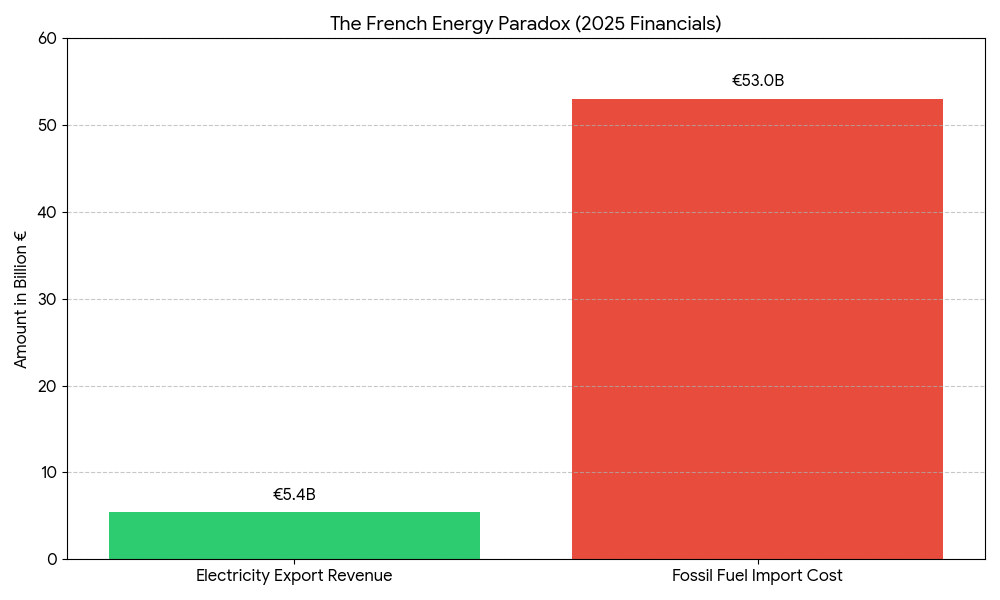
According to the 2025 Electricity Report published by RTE on February 25, 2026, France has solidified its position as Europe’s “Electrical Crossroads.” While the nation celebrated a historic surge in low-carbon energy exports, a sobering financial reality remains: France is still spending ten times more on fossil fuel imports than it earns from selling its surplus power.
At micro2media.com, we analyze why this “success” is actually a loud call for faster electrification to achieve our goal of 80% terrestrial restoration by 2050.
I. 92.3 TWh: A Continental Powerhouse
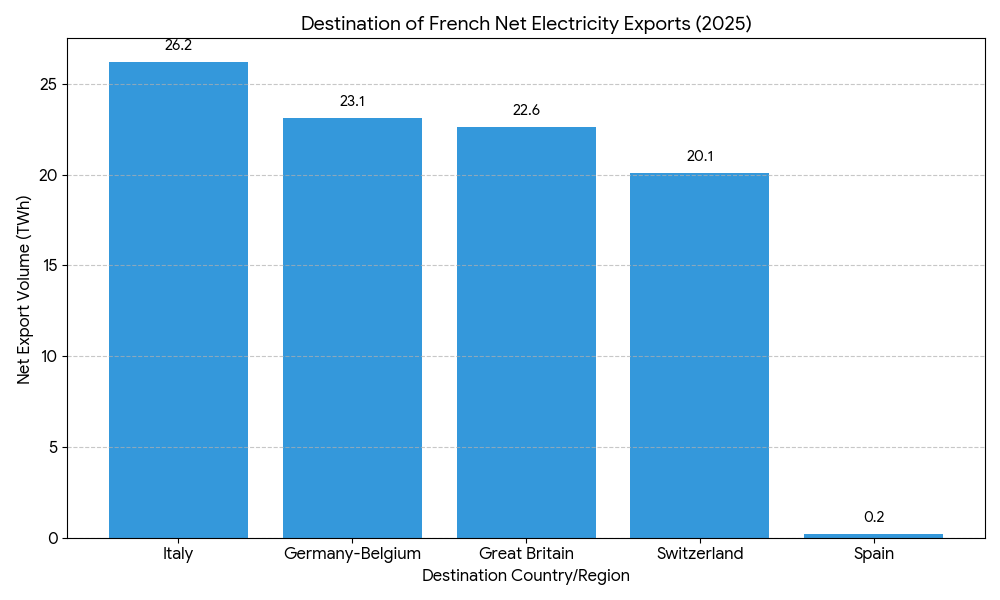
In 2025, France exported a net volume of 92.3 TWh, smashing the previous record of 89 TWh set in 2024. For 99% of the year, France was a net exporter, effectively acting as the battery of Europe.
The Flow of Power
- Italy: 26.2 TWh (The largest beneficiary).
- Germany & Belgium: 23.1 TWh.
- UK: 22.6 TWh.
- Switzerland: 20.1 TWh.
- Indirect Impact: 15% of exports reached non-bordering countries like Poland, Denmark, and Portugal, proving France’s vital role in the EU energy transit.
II. Problem Identification: The €53 Billion Debt
The core issue identified by analysts like Matias Perea is the massive disparity between electricity revenue and fossil fuel spending.
| Identified Problem | The 2025 Reality | Ecological Consequence |
| Financial Imbalance | €5.4B (Electricity Exports) vs. €53B (Fossil Imports). | Wealth drain to petro-states instead of local restoration. |
| Stagnant Demand | Internal demand is 6% lower than pre-crisis levels. | Slow adoption of EVs and heat pumps in domestic sectors. |
| Fossil Dominance | Fossil fuels still represent 56% of final energy consumption. | High carbon footprint in transport and heating. |
III. Benchmarking: France vs. Europe (2025)
| Metric | France | European Average | Advantage |
| Carbon Intensity | 10.9 MtCO2eq (Lowest since 1945) | Significant Fossil Reliance | High (Exporting 27 Mt CO2 savings) |
| Electricity Price | ~€61/MWh (Production) | ~€101/MWh (Weighted Purchase) | High Competitiveness |
| Electrification Rate | 27% (Final Consumption) | Rising | Retard (Delay) |
IV. Solutions for the Future: Reclaiming the Megawatt
The surplus of 92.3 TWh exported to our European neighbors is more than a commercial success; it is a structural warning. While France plays the role of the “Continental Battery,” every megawatt-hour that leaves its borders represents a missed opportunity to slash the €53 billion fossil fuel debt that continues to weigh on the national economy and the environment. To reach the ambitious goal of 80% terrestrial restoration and biodiversity recovery by 2050, we must shift from being an energy merchant to an energy “internalizer.”
The solution lies in a multi-layered “Local-First” Strategy that transforms our electrical abundance into a tool for total industrial and residential decarbonization.
1. Industrial Re-shoring: Powering the Intelligence Revolution
In 2025, France achieved a milestone that many thought impossible: it attracted €69 billion in data center and AI infrastructure investments, effectively outpacing the United States in per-capita tech growth. This surge is driven by one thing: the availability of stable, low-carbon, and relatively cheap electricity.
However, the current model of exporting surplus power while importing AI services is inefficient. We must use our electrical surplus to power these “digital factories” on home soil. By doing so, France can become the global hub for Green Computing.
- The “Waste Heat” Opportunity: Data centers are massive heat producers. By mandating that new data centers integrate with local district heating networks, the energy used to power a query in a server can be recycled to heat homes in the 2nd arrondissement of Paris or the suburbs of Lyon.
- Economic Circularity: Instead of selling raw electricity for a few cents per kilowatt-hour, we “sell” the processing power generated by that electricity, keeping the added value within the French economy to fund ecological initiatives.
2. The Thermal Transition: Ending the Gas Monopoly
The most glaring inefficiency in the French energy mix is the 56% of final energy consumption still derived from fossil fuels. Most of this goes toward heating buildings and industrial processes. While we export clean electricity to help the UK or Germany balance their grids, millions of French households still rely on gas boilers imported from volatile global markets.
The Heat Pump Revolution: The math is simple: every TWh exported could have replaced the gas used in approximately 100,000 French homes if converted to high-efficiency heat pump systems.
- Accelerated Subsidies: The €53 billion currently leaving the country to pay for fossil fuels should be redirected into a “National Thermal Shield.” By front-loading subsidies for heat pumps and industrial electric furnaces, France can “buy back” its energy independence.
- Industrial Electrification: For heavy industries like glass, steel, and chemicals, the transition from gas-fired ovens to electric arc furnaces or plasma torches is the only way to meet net-zero targets. The surplus electricity acts as the financial cushion that makes this expensive transition viable for French manufacturers.
3. The Green Hydrogen Highway
Not everything can be plugged into a battery. Heavy-duty transport, shipping, and certain chemical processes require a high-energy-density fuel. This is where the electrical surplus finds its most strategic use: Green Hydrogen.
By deploying large-scale electrolyzers at the nodes of the national grid, France can transform its 92.3 TWh surplus into a “liquid battery.” This hydrogen doesn’t just replace diesel; it acts as a buffer for the grid. When the wind blows and the sun shines (creating even more surplus), electrolyzers ramp up. When the grid is tight, they ramp down. This flexibility is the key to managing a 100% renewable and nuclear grid without relying on gas-fired peaker plants.
4. Orbital Integration: Space-Based Solar Power (SBSP) as the Ultimate Baseload
By 2050, the demand for electricity will likely double as we eliminate oil and gas. Terrestrial solar and wind, while essential, require vast amounts of land—land that we desperately need for ecological restoration and biodiversity.
This is where the Orbital Energy Revolution becomes the final piece of the puzzle. Space-Based Solar Power (SBSP) involves satellite constellations that capture solar energy in geostationary orbit, where the sun never sets and there are no clouds.
- The 80% Restoration Goal: Because SBSP delivers energy via high-frequency microwaves to small “rectenna” sites on Earth, it has a physical footprint 90% smaller than equivalent terrestrial solar farms.
- The 24/7 Solution: SBSP provides a constant, uninterrupted baseload of power. This allows us to decommission older, less efficient land-based infrastructure and return millions of hectares to wild forests and natural carbon sinks.
- Direct Beam Technology: By 2050, this technology will allow France to direct power precisely where it is needed—whether to an industrial zone in the North or a remote hydrogen production plant—without the need for thousands of miles of new high-voltage land lines.
5. From Exporting Megawatts to Importing Nature
The “Local-First” strategy is a shift in mindset. We must stop viewing our energy surplus as a commodity to be traded and start seeing it as the raw material for our own survival.
By internalizing the 92.3 TWh, we stop the €53 billion leak, we lower the cost of living for French citizens, and we create the fiscal space needed to re-wild 80% of our industrial and agricultural land. The future of France isn’t just as the “Powerhouse of Europe,” but as the first post-fossil, high-tech, bio-diverse nation on the planet.
Solutions Benchmark Table
| Solution | Implementation Scale | Impact on Fossil Imports | Land Use Strategy |
| Heat Pump Switch | National (Residential) | High (Reduces Gas) | Zero new land required |
| Data Center Recycling | Urban Hubs | Medium (Value Add) | Efficient brownfield use |
| Green H2 Network | Industrial Corridors | High (Reduces Diesel) | Reuses existing pipes |
| SBSP Integration | Global/Orbital | Critical (Baseload) | Returns 80% land to nature |
Related Content
- Montel | EU Energy Outlook 2060
- Fast-Tracking the Guarantee of Origin Scheme for Green Hydrogen and Renewable Electricity
- How a Simple “Ping” Is Making the Web More Efficient
- 2026 Sustainability Roadmap: Expert Solutions for an Eco-Friendly Future
- How to Master 4-Dimensional Ecology: Essential Steps for 2026
- How to Build a Fossil-Free Future: 5 Lessons from China’s 2026 Energy Revolution
- Green Hustle: Making Sustainable Living Seriously Fun
- Electricity Analysis and data portal | RTE
- View data published by RTE – RTE Services Portal
- Updates on France – by Julien Jomaux – GEM Energy Analytics
- Electricity 2025 – Analysis and forecast to 2027