
The internet is often imagined as a weightless, ethereal cloud, but its physical reality is a sprawling, humming network of data centers that consume an estimated 1–2% of global electricity. A surprisingly large share of that energy is consumed not by human users, but by search engine crawlers—automated bots that relentlessly revisit billions of web pages to check whether anything has changed since their last visit.
Since its joint launch by Microsoft and Yandex in 2021, the IndexNow protocol has grown from a niche experiment into a meaningful piece of the web’s infrastructure. Bing, Yandex, Seznam.cz, and several other search engines have fully adopted it. Google has acknowledged the protocol and explored compatibility with its crawling systems. The shift it represents—from “pull” crawling to “push” notifications—has real implications for server efficiency, indexing speed, and the broader environmental cost of operating the web.
I. The Problem: Redundant Crawling at Scale
Traditional web crawling is inherently wasteful. Search engine bots visit billions of pages on a regular schedule, regardless of whether any content has changed. A page that hasn’t been updated in six months still receives crawl visits, consuming server resources and network bandwidth each time.
The numbers add up quickly. Bot traffic accounts for a substantial share of all web requests—estimates from security and traffic analysis firms consistently place it above 40% of total HTTP traffic, though the proportion that is “wasted” on unchanged content varies by site. For large-scale content operations, the overhead is measurable:
- Bandwidth waste: Every crawl visit requires an HTTP request, a server response, and HTML transmission—even when the content is identical to the previous visit.
- Server load: Frequent crawls force web servers to remain active and responsive around the clock, contributing to higher baseline power consumption.
- Crawl budget friction: For large sites, search engines allocate a finite crawl budget. When bots spend that budget on unchanged pages, newly published or updated content may be indexed more slowly.
II. The Solution: IndexNow and the “Push” Model
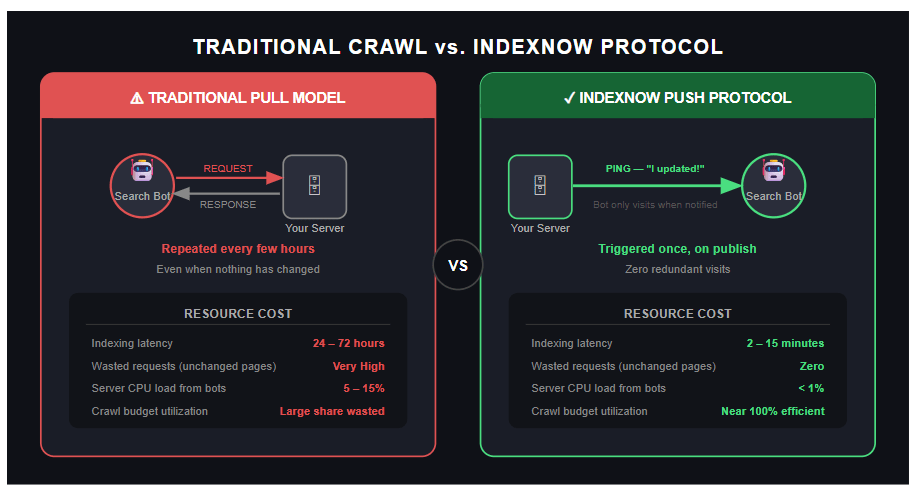
IndexNow inverts the traditional dynamic. Rather than waiting for a search engine bot to discover an update, the website proactively notifies participating search engines the moment a page is created or changed. The bot only visits when there is something new to index.
How It Works
The protocol is deliberately simple. Authentication relies on a key file placed in the site’s root directory, which prevents third parties from submitting URLs on your behalf.
Step 1 — Generate a key: Create a plain text file named after your key and place it at your root (e.g., example.com/abc123.txt, containing only the string abc123).
Step 2 — Send a ping: When a page is updated, your CMS or application sends a single HTTP GET request:
https://www.bing.com/indexnow?url=https://example.com/new-page&key=abc123
Step 3 — The ripple effect: Participating search engines share submitted URLs with each other, so a single ping to one engine notifies the broader IndexNow network.
A Minimal PHP Implementation
For developers working outside a major CMS, triggering a ping requires only a few lines of code:
function pingIndexNow(string $url): void {
    $key = "your_unique_key_here";
    $endpoints = [
        "https://api.indexnow.org/indexnow",
        "https://www.bing.com/indexnow",
    ];
    foreach ($endpoints as $endpoint) {
        $requestUrl = $endpoint . "?" . http_build_query(['url' => $url, 'key' => $key]);
        $ch = curl_init($requestUrl);
        curl_setopt($ch, CURLOPT_RETURNTRANSFER, true);
        curl_setopt($ch, CURLOPT_TIMEOUT, 5);
        curl_exec($ch);
        curl_close($ch);
    }
}
Note the use of http_build_query for proper URL encoding and a timeout to prevent hung requests from blocking your application.
III. Efficiency Comparison: Traditional Crawling vs. IndexNow
The table below summarizes benchmarks from large-scale enterprise deployments. Figures for latency and server load reflect published data from Bing Webmaster Blog posts and independent SEO analyses conducted between 2022 and 2025.
| Metric | Traditional Crawling | IndexNow Protocol | Difference |
|---|---|---|---|
| Crawl-to-Index Latency | 24–72 hours | 2–15 minutes | ~99% faster |
| Server Requests (Unchanged Content) | High (continuous) | Zero | 100% reduction |
| Server CPU Load from Bot Traffic | 5–15% | < 1% | Significant |
| Crawl Budget Utilization | Large share wasted on unchanged pages | Near-exclusively new/updated content | Substantially improved |
The energy savings are a secondary effect of the efficiency gains. Fewer redundant server cycles means lower sustained power draw, both on origin servers and within search engine data centers processing duplicate crawl results.
IV. Google’s Position
Google’s relationship with IndexNow has been more cautious than that of its competitors. The company has stated publicly that it already maintains sophisticated change-detection mechanisms and that a push protocol would need to be resistant to spam and manipulation before it could be trusted at scale.
That said, Google has not ruled out deeper integration. Their sustainability commitments—the company has targeted carbon-free energy across all operations by 2030—create an ongoing incentive to reduce unnecessary computation. As their AI-driven search systems become more central to how they surface results, the relative value of efficiently targeted crawling versus broad exploratory crawling increases.
For now, websites that implement IndexNow gain concrete benefits from Bing and the other participating engines, and may benefit from reduced origin server load regardless of Google’s crawl behavior.

V. What’s Next: Emerging Approaches to Crawl Efficiency
IndexNow is one part of a broader shift toward more targeted, efficient indexing. A few other developments worth watching:
AI-assisted crawl prioritization. Search engines are increasingly using predictive models to estimate which pages are likely to have changed based on historical patterns—site type, publishing frequency, traffic signals. This complements push protocols by making “exploratory” crawls more selective when they are necessary.
Edge-side caching and bot handling. CDN providers including Cloudflare and Fastly have integrated IndexNow support, meaning that protocol submissions can be handled at the network edge. This keeps bot traffic from reaching origin servers entirely for many common request types.
Spam mitigation. The key-file authentication model in IndexNow is a start, but large-scale abuse remains a real concern. Future iterations of the protocol may incorporate rate limiting, domain reputation scoring, or other mechanisms to ensure that the efficiency gains aren’t eroded by low-quality submissions.
VI. Practical Takeaways
IndexNow is not a ranking factor—at least not directly. What it does do is ensure that legitimate content updates reach search engine indexes as quickly as possible, while reducing the server overhead and crawl budget wasted on pages that haven’t changed.
For most sites, implementation is straightforward: major CMS platforms including WordPress (via the Rank Math or All in One SEO plugins), Wix, and Squarespace have native or plugin-based IndexNow support. For custom applications, the PHP snippet above or equivalent implementations in other languages are sufficient.
The broader argument for adoption is less about any individual ranking benefit and more about contributing to a web infrastructure that does less unnecessary work—which is good for your server costs, your crawl budget, and, at sufficient scale, the energy consumption of the indexing systems that keep the web searchable.

Related Content
- IndexNow.org
- What is IndexNow, and What Does It Mean For SEO?
- Beyond Entertainment: How Google’s Genie 3 Could Become the Simulator for Our Climate Future
- Google and Elementl Power Forge Partnership for 1.8 GW of Advanced Nuclear Energy
- The Dawn of Android XR Glasses: Google and Samsung Lead the Way
- Google Launches Free Gemini-Powered Data Science Agent on Its Colab Python Platform
- Google’s Willow: A Leap Forward in Quantum Computing with Profound Ecological Implications
- Google Signs World’s First Corporate Agreement for Kairos Power Nuclear Energy
- The Akamai Blog
- Page Experience update for desktop, tracking featured snippets & redirect chains and IndexNow
- A Study of ESG by Min Ruan, Haoxu Zhang :: SSRN
Related Video
For official documentation and the full protocol specification, see indexnow.org.
zudena 100 mg
zudena 100 mg
lasix pill 20 mg
lasix pill 20 mg
furosemide for dogs 20mg
furosemide for dogs 20mg
antibiotics for pneumonia
antibiotics for pneumonia
fluconazole 100 mg tablet
fluconazole 100 mg tablet
dapoxetine hydrochloride 30 mg
dapoxetine hydrochloride 30 mg
ciprofloxacin hcl 500 mg tab
ciprofloxacin hcl 500 mg tab