
What if the solutions we’re celebrating today are actually creating tomorrow’s problems?
We’ve all heard the headlines: electric cars will save us, solar panels are the answer, we just need to plant more trees. But what if our approach to solving climate change is fundamentally flawed—not because we’re trying, but because we’re only looking at part of the picture?
The Problem with “Green” Labels
Here’s the uncomfortable truth: many products marketed as “green” are only green from one angle.
Think of it like looking at a building. If you only see the front entrance with its beautiful glass façade, you might think it’s stunning. But walk around the side and you might discover crumbling walls, or look at the roof and see dangerous structural problems.
The same thing happens with environmental solutions. We celebrate electric cars because they don’t produce exhaust fumes (the front view), but we ignore the massive mining operations required to build their batteries (the side view) and the fact that they’ll need to be replaced in a decade (the view from above).
To truly solve our environmental crisis, we need to look at every solution from four different perspectives:
The Four Perspectives That Matter
1. Materials: Where Does It Come From?
Every product is made of something. The first question we need to ask is: are we borrowing these materials from nature’s cycles, or are we permanently taking them?
The key metric: Can these materials be returned to nature or reused indefinitely?
Example: A wooden chair made from sustainably harvested trees can eventually decompose and return nutrients to the soil. A plastic chair made from petroleum will outlast your great-great-grandchildren—and not in a good way.
2. Energy: What’s the Real Cost?
This isn’t just about whether something runs on electricity or gas. It’s about the total energy picture: how much energy went into making it, how much it uses, and how efficiently it converts that energy into useful work.
The key metric: How much energy do we waste versus how much we actually use?
Example: Using a 2-ton vehicle to move a 150-pound person isn’t just inefficient—it’s absurd. It’s like using a sledgehammer to crack a nut.
3. Life: Does It Help or Harm Living Systems?
Does this solution work with nature or against it? Does it create space for other species to thrive, or does it push them out?
The key metric: Does biodiversity increase or decrease?
Example: A massive solar farm in the desert might reduce carbon emissions, but if it destroys a fragile ecosystem that took millennia to develop, we’ve traded one problem for another.
4. Time: Will It Last?
This is about resilience and longevity. Will this solution still work in 50 years? Can it adapt to changing conditions? What happens when it breaks down?
The key metric: Can it survive without constant inputs from a fragile global supply chain?
Example: A simple water pump powered by wind can run for decades with basic maintenance. A high-tech smart irrigation system that requires cloud servers, software updates, and rare computer chips? Not so much.
The Model – Descriptive Geometry for a Dying Planet
In classical engineering, Descriptive Geometry is the science of representing three-dimensional objects on a two-dimensional plane. It allows an architect to see the “truth” of a building by looking at its front, top, and side views simultaneously.
Today, our ecological “solutions” are failing because we are looking at them from only one angle—usually the Carbon angle. We call a car “green” because its front view (emissions) looks clean, while ignoring its side view (resource extraction) and its top view (energy entropy).
To save the biosphere, we must adopt the 4D Ecological Model. We must project every human intervention onto four distinct axes:
1. Axis X: The Material Plane (The “Body”)
In geometry, this is the horizontal footprint. In ecology, it measures Composition and Decay.
- The Metric: Circularity vs. Extraction.
- The 4D Test: Does this object “borrow” atoms from the Earth, or does it “steal” them? A solution that requires mining rare earth metals that cannot be recovered is a “geometric leak.”
2. Axis Y: The Energy Plane (The “Flow”)
This is the vertical axis of intensity. It measures Thermodynamic Elegance.
- The Metric: Energy Return on Investment (EROI) and Exergy.
- The 4D Test: How much “disorder” (entropy) does this solution create? Using a massive battery to move a small person is an “energy mismatch”—a tower built on a toothpick.
3. Axis Z: The Biological Plane (The “Depth”)
This is the axis of the living world. It measures Biospheric Integration.
- The Metric: Biodiversity Net Gain.
- The 4D Test: Does this solution displace life or enhance it? A massive solar farm in a desert might save carbon, but if it destroys a fragile ecosystem, it lacks “Z-depth.”
4. Axis W: The Temporal Plane (The “Time”)
The fourth dimension is Time and Resilience.
- The Metric: Adaptability and Longevity.
- The 4D Test: Will this solution work in 100 years? Is it “Anti-fragile”? If it depends on a global supply chain that could collapse, it has a “W-score” of zero.
The Five Critical Challenges We Face in 2026
When we apply this four-dimensional thinking to today’s environmental landscape, five major challenges emerge:
1. The AI Energy Crisis
Data centers and artificial intelligence are consuming staggering amounts of electricity—and the demand keeps growing. We’re trying to build a green future using tools that are straining our power grids to the breaking point.
The smarter solution: Instead of building bigger power plants, we need intelligent microgrids—small, local energy systems that generate and share power right where it’s needed. Think of neighborhoods that produce their own solar energy and use AI to distribute it efficiently, rather than relying on massive, centralized power stations hundreds of miles away.
2. The Mining Paradox
We’re destroying the earth to save the sky. The “green” transition requires vast amounts of lithium, cobalt, copper, and rare earth metals. We’re literally tearing apart mountains to build batteries and solar panels.
The smarter solution: What if we could grow materials instead of mining them? Researchers are already using mushroom roots (mycelium) to create biodegradable materials stronger than plastic, and engineering bacteria to produce structural components from captured CO₂. It sounds like science fiction, but it’s happening now.
3. Biodiversity Collapse
Climate change isn’t just about temperature—it’s about the intricate web of life that makes our planet habitable. As species disappear and ecosystems unravel, we lose the natural systems that clean our water, pollinate our crops, and stabilize our climate.
The smarter solution: “Sponge cities” that function like forests within urban environments. These designs use green corridors, wetlands, and permeable surfaces to absorb stormwater, cool neighborhoods naturally, and provide habitats for birds, insects, and other wildlife. Cities don’t have to be biological dead zones.
4. Water Stress
Droughts are crippling the very energy systems we need for the green transition—hydroelectric dams, nuclear cooling systems, and agricultural production all depend on water that’s becoming increasingly scarce.
The smarter solution: Technologies that harvest water directly from the atmosphere, even in dry climates. Combined with smart conservation systems, these can provide water independence without depleting rivers and aquifers.
5. The Carbon Storage Problem
Planting trees is wonderful, but forests can burn. We need ways to lock carbon away permanently, not just temporarily.
The smarter solution: Converting CO₂ directly into solid minerals for construction. Carbon-negative concrete literally turns greenhouse gases into building materials that will last for centuries.
The 4D Geometric Assessment Process
To visualize the 4D Ecological Descriptive Geometry and how it ranks the current 5 Critical Challenges we face in 2026, we need to translate these abstract dimensions into clear, comparative visuals. Below are the charts and the systemic breakdown of the assessment process.
In our model, every solution is subjected to a “Stress Test” across four planes. This is not a simple checklist; it is an integration test. If a solution scores a 10 in Climate (Z) but a 2 in Matter (X), the resulting “shape” is distorted and unstable.
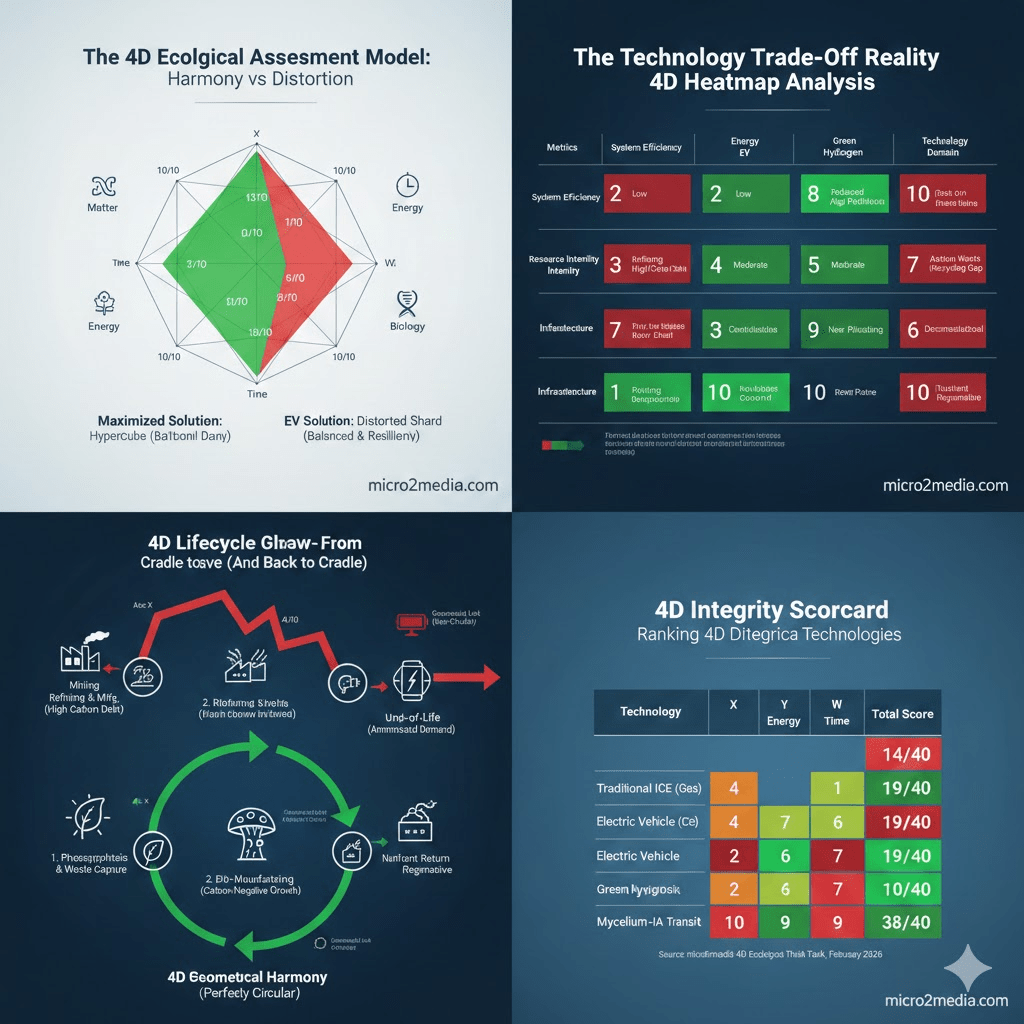
How to read the 4D Shape:
- The Symmetrical Diamond: Represents a “Maximized” solution. It is balanced, meaning it doesn’t solve one problem by creating another.
- The Shard: A long, thin spike toward “Climate” but a collapsed base in “Matter.” This indicates a solution that will eventually fail due to resource wars or waste management crises.
Redrawing the Map
Progress is not about moving faster; it’s about moving smarter across all dimensions. The Electric Vehicle for example, was a “necessary” step to break our addiction to oil, but it is not the destination.
The destination is a world of Geometric Harmony, where our technology doesn’t just “pollute less,” but actively functions like a forest—cleaning the air (Z), using ambient energy (Y), recycling its own body (X), and growing stronger over time (W).
For the micro2media community, the mission is clear: Stop building 2D apps for a 4D world. Start designing for the hypercube. To finalize our model, we must identify the “Critical Path”—the five specific issues that, if solved, would stabilize the entire 4D structure of our planet.
By projecting current 2026 data into our 4D Ecological Descriptive Geometry, we can rank existing solutions and identify the “Maximized” ones that will define the next decade of progress.
Ranking & Proposals: The 4D Scorecard for the 5 challenges (2026)
Here is how current 2026 solutions rank, and the Maximized Proposals.
| Issue | Current Solution (Rank) | Maximized 4D Proposal | Integrity Score |
| Energy | Grid Electrification (EVs) | Edge-AI Managed Micro-grids | 36/40 |
| Resources | Lithium Mining/Recycling | Bio-Manufacturing (Mycelium/Algae) | 38/40 |
| Biodiversity | Protected Nature Parks | Regenerative “Sponge” Cities | 35/40 |
| Water | Desalination Plants | Atmospheric Water Harvesting (Edge Tech) | 34/40 |
| Carbon | Nature-Based Credits | Mineralization (CO2 to Concrete) | 37/40 |
Case Study: The Electric Vehicle Reality Check
Let’s examine the poster child of green technology: the electric car.
What We’re Told:
Electric vehicles are clean, zero-emission transportation for the future. They’re saving the planet.
The Four-Dimensional Reality
Materials: Producing a single EV battery requires mining and processing about 250,000 kilograms of raw earth to extract 500 kilograms of usable materials. That’s equivalent to excavating half the weight of a blue whale for every car.
Energy: You’re using 2,000 kilograms of advanced technology to transport an 80-kilogram person. The energy efficiency looks good on paper, but the overall system is wildly inefficient. Plus, much of the electricity charging these cars still comes from fossil fuels.
Life: The mining operations for lithium and cobalt are devastating local ecosystems. Communities near these mines face water contamination, habitat destruction, and health problems.
Time: EV batteries degrade significantly after 10-12 years. Unlike a mechanical engine that can be rebuilt and last for decades, most EV batteries will need complete replacement—creating massive waste.
The verdict: Electric vehicles are better than gas-guzzlers, but they’re not the solution. They’re a temporary step forward that creates new problems we’ll have to solve.
Let’s use our 4D Descriptive Geometry to evaluate the current “hero” of the green transition: the Electric Vehicle.
The 2D Projection (What we see):
- On a standard 2D chart, the EV is a winner. It produces zero tailpipe CO2. If you only look at the Climate Axis (Z), it looks like progress.
The 4D Reality (The hidden distortions):
- Axe X (Material Distortion):
- An average EV battery requires the extraction of 250,000 kg of raw earth to produce just 500 kg of battery materials. This is a Material Catastrophe. We are solving an atmospheric problem (carbon) by creating a crustal problem (mining) – Rank: 2/10
- Axe Y (Energy Distortion):
- The “Weight Ratio” of an EV is absurd. You are using 2,000 kg of high-tech machinery to transport an 80 kg human. Geometrically, this is an inefficient volume. Furthermore, the energy used to charge the car often comes from a grid that is still 60% fossil-fueled – Rank: 5/10
- Axe W (Temporal Distortion):
- Batteries have a “decay rate.” In 12 years, the car’s value and utility drop significantly. Unlike a simple mechanical engine that can be repaired for a century, the EV is a “disposable high-tech” item – Rank: 4/10
Conclusion on EVs: The EV is a “Flat Solution.” It solves the CO2 problem but fails on every other geometric axis. It is a 3-ton bandage on a 4-dimensional wound.
The “Musk Paradox”: When Ecology Meets the Bottom Line

The rise of the Electric Vehicle cannot be discussed without addressing the figure of Elon Musk, whose relationship with ecology is a masterclass in industrial hypocrisy. While Musk marketed Tesla as a crusade to “save the planet,” critics argue that the environmental mission has often been a convenient surfboard used to ride the wave of massive government subsidies—totaling billions of dollars—and a burgeoning “green” market. The hypocrisy is laid bare when one projects Musk’s actions onto our 4D model: while pushing the “clean” image of EVs (Axe Z), he simultaneously operates SpaceX, whose rocket launches and planned “megaconstellations” create massive atmospheric and orbital disturbances. Furthermore, his recent pivot to support political figures who dismiss climate change as a “hoax” and his public dismissal of agricultural climate impacts suggest that for Musk, ecology is a variable that can be discarded whenever it conflicts with profit or political power (Axe W). In our 4D view, Tesla is less a revolution in sustainability and more a revolution in capitalist extraction, designed to replace one high-consumption machine (the ICE) with another high-consumption machine (the EV), ensuring that the cycle of buying and “upgrading” never ends.
Why the EV is not “The Way” (The Musk Illusion) – Elon Musk has famously called fuel cells “fool cells.” From a pure Axe Y (Energy Efficiency) perspective, he is right. However, our 4D model reveals the hypocrisy: focusing only on efficiency ignores the Axe X (Matter) catastrophe of mining. Surfing the “green wave” to sell heavy, mineral-intensive batteries is a financial masterstroke, but a geometric failure. Musk’s model relies on infinite extraction—a 1D concept—to solve a 4D crisis.
Any Different Curve for EVs? The Hydrogen Alternative? The Bio-AI Alternative?
To truly grasp the future of sustainability, we must distinguish between the current market “heroes” and the emerging architectural shifts. In our 4D Ecological Model, we evaluate these technologies not just by their carbon footprint, but by their systemic integrity.
Currently the market favorite, EVs excel on Axe Z (Biology) by eliminating urban smog and Axe Y (Energy) due to their high motor efficiency. However, they suffer from a severe “material debt” on Axe X (Matter) because of the intensive mining required for batteries (lithium, cobalt). The EV 2D Solution (Motion + Low CO2) adds a vital environmental dimension by cleaning urban air. However, it remains “flat” because it compensates for its cleanliness with a massive material debt (crustal extraction).
Often the “cleaner brother,” Hydrogen scores higher on Axe X (Matter) because fuel cells require fewer rare earth metals than massive batteries. It is the champion of Axe W (Time/Resilience) for heavy-duty transport (ships, planes, and long-haul trucks) where batteries are too heavy. However, it fails on Axe Y (Energy) because converting electricity to gas and back is highly inefficient, losing nearly 70% of the energy in the process. Hydrogen represents the move toward a 3D Solution (Motion + Carbon + Resilience): By shedding battery weight and providing energy density for heavy transport, it adds the depth of temporal resilience (Axis W). It is a sturdier “spine” for global trade, though still energetically expensive.
Bio-AI – The 4D Diamond: This represents the “Maximized” future. Instead of mining for batteries or taxing the grid with hydrogen conversion, Bio-AI uses the Earth’s own “code.” It employs Bio-manufacturing to “grow” materials from waste (Axe X) and uses Edge AI to orchestrate energy flows with nature-mimicking efficiency (Axe Y). It is the only technology that achieves symmetry in our 4D model, turning a human invention into a restorative part of the biosphere. Bio-AI is the culmination as a 4D Solution (Total Harmony). This is the final stage where technology stops “reducing impact” and starts merging with natural cycles. It uses intelligence to coordinate biological growth with human needs.
The “Maximized” Solutions – High-Tech Progress in 4D
If electric vehicles and hydrogen are imperfect, what are the “maximized” solutions that rank high across all four dimensions? Real environmental solutions don’t just reduce harm—they actively improve the systems they’re part of. These are the technologies of the future that represent genuine progress.
Consider biological manufacturing, where instead of building products in traditional factories that extract and assemble materials, we use synthetic biology to literally grow what we need. Mycelium—the root structure of mushrooms—can be cultivated to create packaging, building materials, and even vehicle components that are stronger than plastic but completely biodegradable and carbon-negative. Using bacterial cellulose, we can grow chassis and interiors that feed the soil when their useful life ends. This approach scores exceptionally high on materials (it’s biodegradable) and life (it feeds ecosystems rather than depleting them), representing a fundamental shift from extraction to cultivation.
Then there’s the solid-state revolution in energy systems. Rather than building massive centralized infrastructure with “dumb” batteries, we need smart, distributed systems powered by AI-driven edge technology. Solid-state batteries eliminate the liquid components that make current batteries prone to fires, and when combined with vehicle-to-grid software, your car becomes a mobile battery that can stabilize your neighborhood’s energy grid. Your home becomes a tiny power plant. Your neighborhood shares energy. AI coordinates everything to minimize waste, eliminating the need for giant power lines and vulnerable central grids. This creates systemic resilience, scoring high on the time dimension because it builds adaptability into the infrastructure itself.
Finally, we need digital ecosystem monitoring that transforms how we understand our planet’s health. Using high-tech sensors and artificial intelligence, we can create real-time, comprehensive maps of environmental conditions that allow us to predict problems before they become crises. This precision saves enormous amounts of energy by allowing targeted interventions rather than broad, wasteful approaches. Instead of reacting to environmental disasters after they happen, we can see the warning signs and prevent them. We stop playing catch-up and start getting ahead of the curve.
Underlying all of this is the need for long-term thinking—designing for centuries rather than quarterly profit reports. We need technologies that can be maintained locally, that adapt to changing conditions, and that don’t depend on rare materials extracted from unstable supply chains halfway around the world.
Comparing the Future of energy (4D Ranking)
| Dimension | Internal Combustion | Electric Vehicle | Hydrogen (Green) | Maximized Bio-Tech |
| X (Matter) | 4 | 2 | 6 | 10 |
| Y (Energy) | 2 | 7 | 4 | 9 |
| Z (Biology) | 1 | 6 | 7 | 10 |
| W (Time) | 7 | 4 | 8 | 9 |
| TOTAL | 14 | 19 | 25 | 38 |
4D Ecological Model Verdict
| Axis | Electric Vehicle (EV) | Hydrogen (H2) | Bio-AI (The Maximized Path) | Winner |
| Axe X: Matter | 2/10 – Heavy “Mining Debt” (Lithium, Cobalt). | 6/10 – Fewer rare minerals, but high-tech tanks. | 10/10 – Bio-manufacturing. Grows materials from waste. | Bio-AI |
| Axe Y: Energy | 7/10 – Efficient engine, but system-wide weight waste. | 3/10 – “Energy Vampire.” Huge conversion losses (~70%). | 9/10 – Thermodynamic Elegance. AI-optimized metabolism. | Bio-AI |
| Axe Z: Biology | 6/10 – Clean air, but local mining “scars” on nature. | 7/10 – Zero toxic runoff, but large physical footprint. | 10/10 – Synergistic. Functions as part of the ecosystem. | Bio-AI |
| Axe W: Time | 4/10 – Battery decay and grid fragility. | 8/10 – High resilience for heavy trade/long storage. | 9/10 – Anti-fragile. Self-repairing and adaptive logic. | Bio-AI |
| Integrity Score | 19/40 (Shard) | 24/40 (Strong Spine) | 38/40 (The Perfect Diamond) | Bio-AI |
Comparison at a Glance
| Technology | Matter (X) | Energy (Y) | Biology (Z) | Time (W) | 4D Score |
| EV | 2 | 7 | 6 | 4 | 19/40 |
| Hydrogen | 6 | 3 | 7 | 8 | 24/40 |
| Bio-AI | 10 | 9 | 10 | 9 | 38/40 |
he Path Forward: True Sustainability
Real environmental solutions don’t just reduce harm—they actively improve the systems they’re part of. Here’s what that looks like:
Biological Manufacturing
Instead of factories that extract and assemble, imagine production systems that grow. Mycelium can be cultivated to create packaging, building materials, and even vehicle components—all biodegradable, all carbon-negative, all using renewable inputs.
Intelligent Energy Systems
Rather than building massive infrastructure, we need smart, distributed systems. Your home becomes a tiny power plant. Your neighborhood shares energy. AI coordinates everything to minimize waste. No giant power lines, no vulnerable central grids.
Digital Ecosystem Monitoring
Real-time, comprehensive tracking of environmental health allows us to predict problems before they become crises. We stop reacting and start preventing.
Long-Term Thinking
We need to design for centuries, not quarters. Technologies that can be maintained locally, adapted to changing conditions, and don’t depend on rare materials from unstable supply chains.
The Honest Conversation About Green Capitalism
We need to talk about something uncomfortable: some of the loudest voices in the “green revolution” aren’t primarily motivated by saving the planet.
Take electric vehicles. They’ve been marketed as an environmental crusade, but they’ve also been a brilliant way to capture billions in government subsidies while ensuring that consumers keep buying expensive vehicles every decade. It’s not about reducing consumption—it’s about shifting what we consume.
This isn’t to say electric cars are bad. It’s to say we need to be clear-eyed about what they are: a better option than gas cars, but still part of a system built on extraction, consumption, and planned obsolescence.
True sustainability means breaking that cycle entirely, not just making it slightly greener.
The Bottom Line
We don’t need more “green” products that solve one problem by creating three others. We need solutions that work in harmony with natural systems—solutions that don’t just do less harm, but actively heal and restore.
That means thinking beyond simple fixes and embracing complexity. It means combining ancient wisdom about living with nature with cutting-edge technology. It means measuring success not just in carbon saved, but in ecosystems restored, materials cycled, energy conserved, and resilience built.
The future isn’t about better batteries or bigger solar farms. It’s about fundamentally rethinking our relationship with the planet—seeing ourselves not as conquerors to be made greener, but as partners learning to work with the living systems that sustain us.
The choice is ours: keep slapping green paint on broken systems, or build something genuinely sustainable.
What You Can Do
Whether you’re an entrepreneur, engineer, developer, or concerned citizen, you can apply four-dimensional thinking to your work and choices:
Before embracing any “green” solution, ask:
- Where do the materials come from, and where do they go?
- What’s the true energy cost across the entire system?
- Does this help or harm the living world?
- Will this work for my grandchildren?
Support genuinely innovative approaches:
- Bio-manufacturing and regenerative agriculture
- Distributed energy systems and local resilience
- Biomimicry and nature-based solutions
- Open-source, repairable, long-lasting design
Demand honesty:
- Support businesses that share complete lifecycle information
- Question green marketing claims
- Look beyond the obvious benefits to the hidden costs
Related Content
- Resilient city perspective: 4D printing in art, architecture and construction – ScienceDirect
- Technological innovation facilitates the practice of “three-dimensional ecology” – PMC
- The Convergence of Health, Ecology, and IT: Smart Solutions for a Sustainable Future
- Sustainability and Ecology: The Future of Aviation with Blended-Wing Aircraft
- The Gulf Stream Could Be in Trouble: Examining the AMOC’s Collapse and Pragmatic Solutions
- Tech and Ecology News Roundup: NordVPN, UK Tech, AI, WordPress, and Climate Change
- Earth Has Six Continents, Not Seven: Radical New Study with Ecological and Sustainability Solutions
- Ecology, the Olympics, and the Future of Our Planet
- Into the fourth dimension: Everyday stuff comes to life | Nesta
- What Dimension Do You Live In? | LinkedIn
- Mapping life’s disparity and evolutionary constraints in a geometric complexity space
- Elon Musk’s Hypocrisy on Carbon Tax and Subsidies