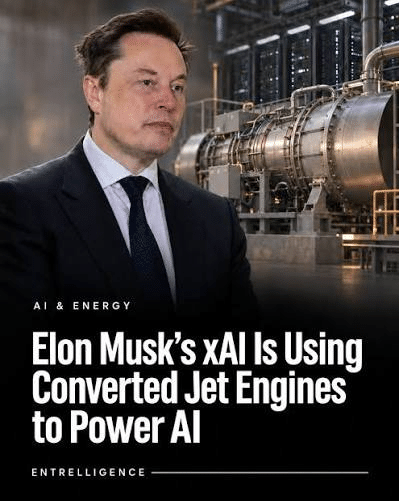
Elon Musk’s xAI has converted eight General Electric aircraft engines—originally mounted on Boeing 747 and 767 aircraft—into natural gas generators to power its Colossus 2 data center. Reconditioned by ProEnergy, each turbine can produce up to 50 MW, delivering a combined 400 MW, roughly enough electricity for 120,000 homes. The permit covers 41 permanent turbines with a total capacity approaching 1.2 GW, as Musk promised this summer to multiply the data center’s capacity by seven. The modified engines were chosen because they can be deployed far faster than grid connections, which typically take years. However, the installation brings significant pollution: the permit allows a carbon monoxide ceiling twice as high for these eight turbines as for certain other installations at the site, along with 25% more volatile organic compounds, including formaldehyde, a known carcinogen. The Southern Environmental Law Center is contesting the state authorization, arguing that xAI underestimated projected emissions and failed to demonstrate compliance with certain limits. It also criticizes the use of reconditioned Boeing engines when modern turbines emit far less. The permit was approved last March despite strong local opposition. xAI has faced legal action for months: the NAACP and environmental groups previously sued over 27 temporary turbines used without what they deemed mandatory federal permits. According to Reuters, 57 turbines operate at Colossus 2, and 30 of them reportedly release nearly 2,500 tonnes of nitrogen oxides and 4,000 tonnes of carbon monoxide per year. Last month, a federal judge refused to dismiss that case. Residents nearby also complain of constant noise, day and night, just a few hundred meters from their homes. Last June, three residents launched a class action against xAI and SpaceX for noise nuisance and loss of property value. To quell the discontent, Musk has offered to buy several houses in the nearby Colonial Hills neighborhood—with a clause prohibiting sellers from joining the lawsuit.