
Let’s be honest, “sustainable living” can sometimes conjure images of drab, self-sacrificing monks living in yurts. But what if I told you it could be less about deprivation and more about discovery? Less about guilt and more about gleeful impact? Welcome to the “Green Hustle” – where saving the planet isn’t just a responsibility; it’s the coolest, most rewarding game in town. Forget the doomsday prophecies for a moment, and let’s dive into a world where every small choice is a high-five to Mother Earth, and a boost to your own well-being. This isn’t your grandma’s eco-guide; this is your front-row ticket to making a genuine difference, all while having an absolute blast.
Green Living: Ditch Dread, Embrace the Rad!
For far too long, the narrative around environmentalism has been steeped in urgency, sacrifice, and often, a hefty dose of fear. While the science is indeed clear about the challenges we face, dwelling solely on the dire can be paralyzing. It’s time to flip the script. Imagine a world where every step towards sustainability feels less like a burden and more like unlocking a new achievement in your favorite game. This paradigm shift is crucial because engagement, not alarm, is the engine of true change. When green living becomes an enjoyable pursuit, something you genuinely look forward to, it stops being a chore and starts being a lifestyle.
The truth is, embracing a more sustainable life opens up a world of creativity, innovation, and often, significant personal benefits. Think about the joy of growing your own herbs, the satisfaction of repairing something instead of replacing it, or the simple pleasure of a bike ride instead of a car trip. These aren’t just eco-friendly actions; they’re acts of self-reliance, mindfulness, and often, community building. They connect us more deeply to our surroundings and to each other, fostering a sense of purpose that often gets lost in our hyper-consumerist society. It’s about rediscovering value beyond the price tag.
Consider the burgeoning movement of “eco-tourism” or the rise of “slow fashion” – these aren’t just buzzwords; they represent a fundamental shift in how people seek experiences and define quality. People are actively choosing vacations that minimize their environmental footprint and supporting brands that prioritize ethical production. This isn’t forced; it’s a conscious decision driven by a desire for authenticity and a connection to values that resonate deeply. This is the “rad” side of green living – where conscious choices lead to richer, more meaningful lives, proving that sustainability isn’t just good for the planet; it’s profoundly good for us, too.
Eco-Hacks: Your Guide to a Sustainable Glow-Up
Let’s get practical. The beauty of sustainable living lies in its accessibility – you don’t need to overhaul your entire life overnight. It’s a journey of small, consistent steps, each one accumulating into a significant impact. One of the simplest yet most effective eco-hacks is rethinking your relationship with food. Food waste alone accounts for about 8-10% of global greenhouse gas emissions, a staggering figure that highlights the power of mindful consumption. By planning meals, using leftovers creatively, and composting food scraps, you’re not just reducing your carbon footprint; you’re often saving money and enjoying fresher, more wholesome meals. It’s a win-win-win scenario that’s surprisingly easy to implement.
Another powerful area for a sustainable glow-up is your energy consumption at home. Simple changes can make a world of difference. Switching to LED lighting, unplugging “vampire” electronics (those that draw power even when off), and optimizing your heating and cooling can drastically cut down on your energy bill and your environmental impact. Think of it as an economic superpower – saving money while saving the planet. Recent studies, like one published in Nature Energy, consistently demonstrate that household energy efficiency improvements are among the most cost-effective ways for individuals to reduce their carbon footprint, often paying for themselves in just a few years.
Pro-Tip: The “One-Thing-A-Month” Challenge. Don’t try to change everything at once. Pick one eco-hack per month – maybe it’s switching to a reusable water bottle, trying a vegetarian meal once a week, or learning to mend a torn garment. By the end of the year, you’ll have twelve new sustainable habits ingrained in your routine, almost effortlessly. It’s about building momentum, celebrating small victories, and realizing that every conscious choice is a step towards a greener, more fulfilling life. The cumulative effect of these small actions is truly immense, creating a ripple effect far beyond your own household.

Planet-Positive: Making Impact the Fun Way
Making a positive impact on the planet doesn’t have to be a solitary endeavor; it can be a vibrant, community-driven experience. Think about joining local clean-up initiatives, participating in community gardens, or even starting a “repair cafe” where neighbors can share skills and fix broken items together. These activities not only contribute directly to environmental health but also foster a sense of belonging and collective purpose. The joy of working alongside like-minded individuals, seeing tangible results, and sharing knowledge transforms sustainability from an abstract concept into a living, breathing part of your local ecosystem. It’s about building resilience and connection, proving that collective action can be incredibly fun and rewarding.
Beyond local efforts, consider how your choices as a consumer can drive systemic change. Every dollar you spend is a vote for the kind of world you want to live in. Supporting businesses that prioritize ethical sourcing, sustainable production, and fair labor practices sends a clear message to the market. This extends to investing in renewable energy options for your home, if feasible, or choosing banks and financial institutions that align with your values by not funding fossil fuel projects. This doesn’t mean becoming an investigative journalist for every purchase, but rather making informed choices for the big-ticket items and consciously seeking out brands committed to a better future. It’s about leveraging your economic power for good.
The rise of citizen science initiatives offers another exciting avenue for planet-positive impact. Projects that monitor local biodiversity, track air or water quality, or even document phenological changes (like the timing of plant flowering) empower everyday individuals to contribute valuable data to scientific research. This direct involvement can be incredibly engaging, turning a walk in the park into a meaningful contribution to climate science. It democratizes research, making scientific discovery accessible and fun for everyone, regardless of their background. It’s a powerful reminder that we all have a role to play in understanding and protecting our planet, and that collective data can drive significant insights.
The “Data Visualizer”: Carbon Impact Comparison of Daily Habits
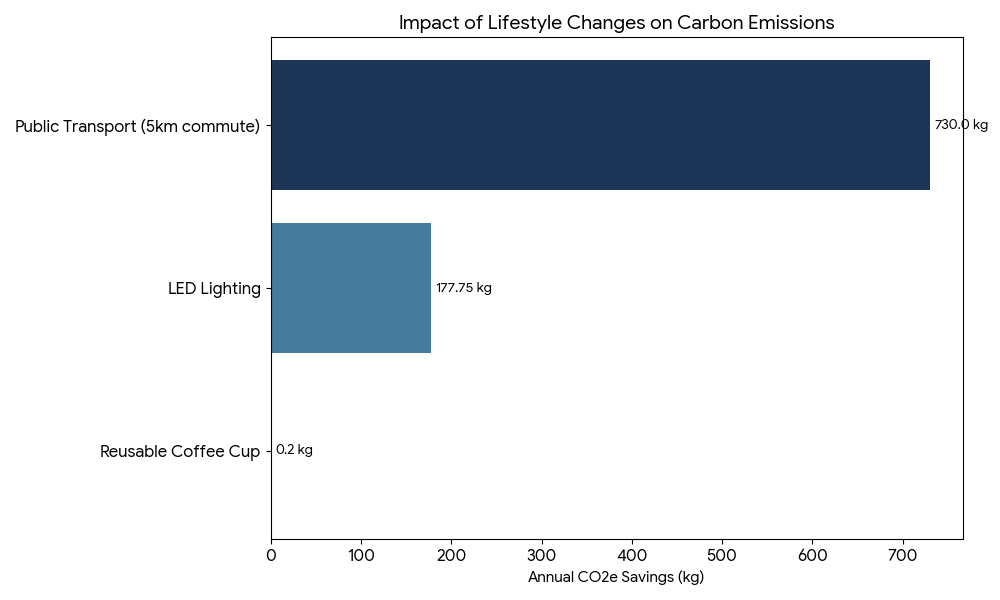
This data highlights a powerful truth for our community: while big shifts like changing how we commute offer massive gains, even the smallest daily habit—like carrying a reusable cup—creates a ripple effect when adopted by millions.
| Habit Change | Annual CO2e Savings (kg) | Explanation |
| Reusable Coffee Cup | 0.2 | Switching from disposable cups prevents manufacturing and waste emissions. |
| LED Lighting | 177.75 | Superior energy efficiency leads to lower electricity-related carbon output. |
| Public Transport (5km commute) | 730.0 | Replacing a daily car commute significantly reduces fuel combustion emissions. |
Future Solutions: The Horizon of Hope
While individual actions are vital, truly tackling climate change requires systemic shifts and groundbreaking technological advancements. The future of sustainability is increasingly looking towards innovative solutions that go beyond simple conservation, embracing regeneration and circularity. One particularly exciting area is carbon capture and utilization (CCU) technologies. While still in relatively early stages for widespread commercial deployment, companies are developing methods to directly capture CO2 from the atmosphere or industrial emissions and transform it into valuable products like building materials, synthetic fuels, or even carbonated beverages. This moves beyond merely reducing emissions to actively removing existing CO2, offering a powerful tool in our climate arsenal. The Intergovernmental Panel on Climate Change (IPCC) consistently highlights the necessity of such negative emissions technologies to meet global warming targets.
Another burgeoning field offering immense hope is the advancement of circular economy principles. This isn’t just about recycling; it’s about fundamentally redesigning products and systems to eliminate waste and pollution, circulate products and materials, and regenerate natural systems. Imagine products designed to be easily disassembled and their components reused or remanufactured, or biological materials safely returned to the earth. Companies like Patagonia have long championed repair and reuse, and now entire industries are exploring “product-as-a-service” models where you lease items like washing machines instead of owning them, ensuring manufacturers are incentivized to design for durability and recyclability. This systemic shift promises to dramatically reduce resource consumption and waste generation.
Furthermore, the rapid evolution of AI and machine learning in optimizing energy grids and resource management presents a transformative opportunity. AI can predict energy demand with unprecedented accuracy, enabling smarter distribution from renewable sources and reducing reliance on fossil fuel “peaker” plants. It can optimize logistics to reduce fuel consumption in transportation, identify inefficiencies in manufacturing processes, and even help manage water resources more effectively in agriculture. These “invisible” solutions, powered by data and algorithms, promise to supercharge our sustainability efforts by making every system more efficient, intelligent, and less wasteful, turning complex challenges into manageable data problems.
So, there you have it: the Green Hustle isn’t a dreary obligation; it’s an invitation to a more vibrant, connected, and genuinely fun way of living. From mastering eco-hacks in your kitchen to advocating for systemic change and embracing future technologies, every action you take, big or small, weaves into a larger tapestry of hope and progress. Don’t wait for perfection; start today. Your micro-habit challenge for this week? Choose one meal to be plant-based. It’s a delicious step for you, and a powerful high-five to our incredible planet. Let’s make sustainable living seriously fun, together!
Related Links
- ecoGreen – the Micro2media Green Community
- Discover the Best 5 Ethical Consumption Brands for Eco-Friendly Living
- Singapore: Leading the Charge in Green Urban Living
- Living Green: Embracing Eco-friendly Practices in Our Daily Lives
- Sustainable Living: How You Can Help Preserve Our Planet
- Embracing Green Products: A Pathway to Sustainable Living
- Our Planet, Our Responsibility: A Comprehensive Guide to Living a Sustainable Lifestyle
- Digital Doc – The Climate Facts of 2025: Living in the Great Transition (Download Presentation)
- The Ripple Effect of Small Changes: How Daily Habits Shape a Cleaner World – Swachhathon
- Small Changes, Big Impact — How Everyday Actions Help the Planet | by Denarius
- The Ripple Effect of Small Eco-Friendly Habits
- From Coffee Lovers to Change Makers: How Ripple Affect Turns Everyday – Ripple Affect Australia
- Key findings and policy implications from a systematic review – ScienceDirect

diflucan generic cost without insurance
diflucan generic cost without insurance
doryx antibiotic
doryx antibiotic
lasix for dogs over the counter
lasix for dogs over the counter
augmentin for pneumonia
augmentin for pneumonia
dutasteride prescription nz
dutasteride prescription nz
linezolid 600mg tab
linezolid 600mg tab
finasteride minoxidil
finasteride minoxidil