
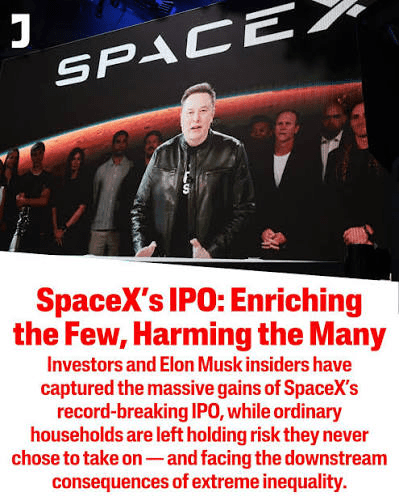
For years, a carefully constructed narrative has positioned Elon Musk as a modern folk hero—a rogue billionaire supposedly fighting for free speech, democracy, and the ecological future of humanity. However, the raw mechanics behind the upcoming initial public offering (IPO) of SpaceX dismantle this facade entirely. Far from protecting the ordinary citizen, the financial engineering surrounding this listing reveals a highly calculated mechanism designed to exploit the public market system and force everyday retail investors to pick up the tab for a heavily debt-laden, deeply unprofitable venture.
The Rigged Playbook: Bending the Nasdaq 100 Rules
A standard IPO relies on rigorous price discovery. Typically, newly listed companies must undergo a “seasoning period”—often lasting three to twelve months—to allow the market to find an organic, stable price. Furthermore, traditional indices require a healthy “free float,” meaning a substantial percentage of the company’s shares must be available to the public to ensure liquidity and prevent extreme price manipulation.
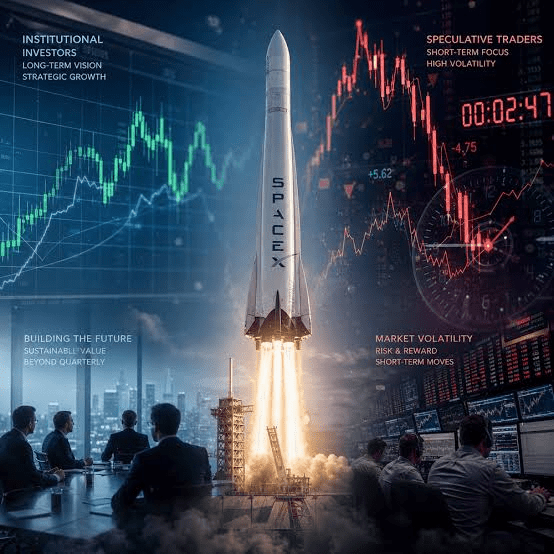
Under normal market conditions, a public listing for SpaceX would face massive headwinds. The company is losing billions of dollars—posting a staggering $4.9 billion loss on $18.7 billion in revenue last year—while aggressively targeting a jaw-dropping valuation of approximately $1.8 trillion. Attempting to debut at a multiple of nearly 100 times its revenue would naturally invite immense skepticism from rational market participants.
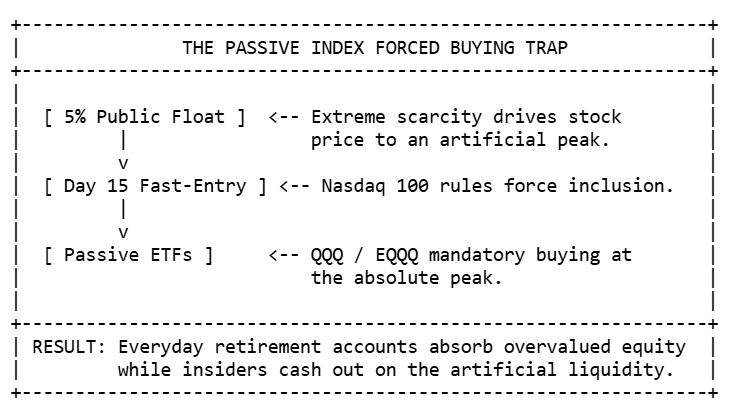
To bypass this hurdle, the financial elite have quietly rewritten the rulebook. In a highly controversial move, Nasdaq altered its core inclusion policies just ahead of the listing. Under these new “Fast Entry” rules, megacap companies can bypass the historic seasoning window and gain entry into the elite Nasdaq 100 index just 15 trading days after their initial public offering. Crucially, Nasdaq also dropped its strict 10% minimum free float requirement. SpaceX intends to float only a tiny, scarce portion of its equity—estimated at roughly 5%—keeping the remaining 95% strictly locked up under founder control.
The ETF Trap: Screwing the Public by Force
This combination of a miniscule public float and a 15-day fast-track entry creates a dangerous systemic bottleneck for passive index funds. Trillions of dollars globally are tied to index-tracking ETFs like the Invesco QQQ Trust (QQQ) or European alternatives like EQQQ and EQQS. These passive vehicles operate on strict mathematical mandates: when a stock enters the underlying index, the fund managers must buy it, completely irrespective of price, valuation, or profitability.
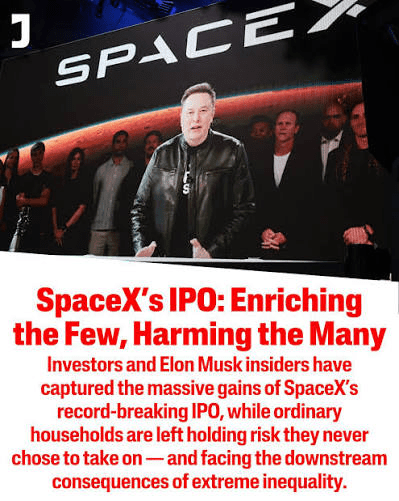
Because only a tiny 5% sliver of SpaceX shares will be available on the open market, early speculative retail trading and hype will easily drive the stock price to an astronomical, artificial peak during the first two weeks of trading. On day 15, the trap springs. Passive ETFs will be legally forced to deploy hundreds of billions of dollars of ordinary people’s retirement money to purchase SpaceX at its absolute highest, most inflated valuation.
This represents a severe failure of open-market neutrality. The artificial scarcity ensures a massive price spike at inclusion, followed by an inevitable correction once the hype subsides and rolling insider lockups begin to release more shares. Everyday citizens who think they are safely investing in a diversified tech ETF will find their portfolios forcibly concentrated in a highly volatile, heavily overvalued rocket company, absorbing the losses while the billionaire class secures liquidity to cover unrelated debts and finance personal vanity projects.
Solutions for the Future: Reclaiming Index Integrity
| Problem | Current Exploitation | Solution for the Future |
| Index Rule Manipulation | Exchanges rewriting parameters (Fast-Entry, dropping float minimums) to court high-profile, mega-cap listings. | Implementing mandatory federal regulatory freezes that prevent index operators from altering inclusion criteria within 12 months of a scheduled IPO. |
| Forced Index Concentration | Passive ETFs forced to buy overpriced equities with thin floats, distorting true price discovery. | Regulators like the SEC should mandate a minimum 20% free-float threshold for any stock automatically forced into broad-market retail ETFs. |
| Fiduciary Blindspots | Corporate governance structures that eliminate shareholder voting rights and strip out fiduciary oversight. | Institutional fund managers must exercise proxy filtering, excluding companies with dual-class shares that offer zero accountability to public investors. |
Call for Action: Protecting the Core of Your Portfolio
The SpaceX listing proves that the global financial architecture can be bent to serve the few at the expense of the many. Fortunately, institutional resistance is beginning to surface; S&P Dow Jones Indices recently stood its ground, refusing to weaken its strict S&P 500 inclusion rules or waive profitability criteria solely to accommodate this listing.
However, because the Nasdaq 100 has fully capitulated, the burden of protection now falls squarely on the individual investor. If you hold standard, market-cap-weighted Nasdaq index funds like QQQ, your hard-earned savings are about to be used as price-insensitive fuel to prop up an inflated valuation. It is time to look past the billionaire PR campaigns of justice and ecology, audit your portfolio, and demand higher structural integrity from the asset managers handling your wealth. Consider shifting capital toward equal-weighted funds or indices that respect historical seasoning rules, ensuring that your financial future is never held hostage by corporate ego.
Related Content
- Daniel Newman Nailed SpaceX’s IPO Reversal. Here’s the Proof.
- The SpaceX Sham – Dissent Magazine
- SpaceX’s trillion-dollar IPO: we will be made to pay for the AI bubble
- Protecting ourselves from SpaceX IPO : r/Bogleheads
- Elon Musk’s xAI Project in Memphis Raises Environmental and Ethical Concerns
- Elon Musk’s Fellowship in the Royal Society: Implications for Ecology and Preserving Our Planet
- Elon Musk and Mark Zuckerberg Lack Moral Values, Says Joseph Stiglitz: Apple as an Ethical Alternative Model
- How to Master 4-Dimensional Ecology: Essential Steps for 2026
- A Molecular Revolution: The Nobel Prize in Chemistry and the MOF-Powered Battle for a Sustainable Planet
- Off-World Industry: Jeff Bezos’s Bold Vision for Earth’s Ecological Future