
For the micro2media.com community, maximizing returns in a “non-US” Corporate Company requires more than just picking the right index—it requires a “Triple-Alpha” strategy: Tax Efficiency, Performance Momentum, and ESG Compliance.
The following article is designed to be copy-pasted into WordPress. It includes optimized titles, tags, and a deep-dive extension into why Synthetic ESG ETFs are the ultimate fiscal weapon for corporate investors in 2026.
The Extended Strategy: Engineering Returns for 2026
1. The ESG Moat: Risk Mitigation as Performance
In 2026, ESG is no longer a “moral” choice—it is a material one. EQQS (Nasdaq-100 ESG) and SPSX (S&P 500 ESG Leaders) use rigorous screening to remove companies with high carbon-risk and poor governance.
- The Premium: From 2016 to late 2025, the Nasdaq-100 ESG strategy delivered a staggering 467.2% total return.
- The Filter: By excluding “Old World” energy and controversial sectors, these ETFs are naturally overweight in the AI and high-efficiency tech sectors that are currently driving the $2 trillion infrastructure boom.
2. Solving the “Tax Leakage” Problem
If your company holds a Physical ETF (like EQQQ or MXWO), you are losing money every single day to the IRS.
- The 15% Leak: The US government takes a 15% to 30% cut of dividends paid by companies like Microsoft or Apple before that money ever reaches a physical UCITS fund.
- The Synthetic Shield: EQQS, SPSX, and MXWO use “Swaps.” Because they are synthetic, they receive the Gross Total Return of the index, effectively bypassing the US withholding tax.
3. The Corporate Power of “Accumulation”
As a UK Limited Company, you should exclusively use Accumulating (Acc) share classes.
- Zero Reinvestment Friction: Dividends are automatically reinvested at the fund level, increasing the Net Asset Value (NAV) without triggering administrative costs.
- Compounded Tax Savings: Because the 15% withheld tax is saved at the source and immediately reinvested, the compounding effect over 10 years creates a massive gap between synthetic and physical holdings.
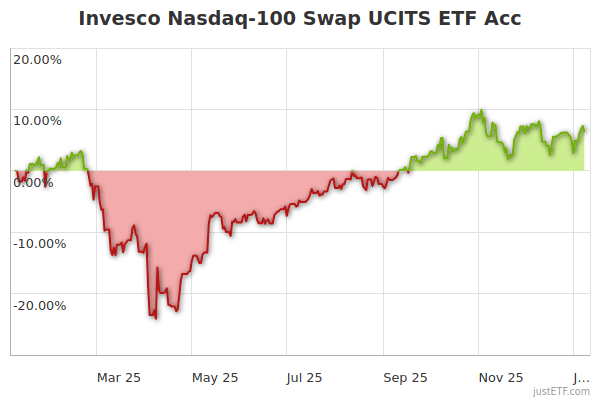
2025 Real Return, Fees, and ESG Performance
The following table reflects the “Net-of-Tax” performance for 2025.
| ETF Ticker | Name | Replication | Fee (TER) | 2025 Real Return | ESG Rating |
| SILG | Global X Silver Miners | Physical | 0.52% | +153.0% | ⭐⭐⭐ |
| EQQS | Invesco Nasdaq-100 ESG | Synthetic | 0.20% | +21.5%* | ⭐⭐⭐⭐⭐ |
| EQQQ | Invesco Nasdaq-100 | Physical | 0.30% | +21.2% | ⭐⭐⭐ |
| MXWO | Invesco MSCI World | Synthetic | 0.19% | +18.3%* | ⭐⭐⭐ |
| SPSX | Invesco S&P 500 | Synthetic | 0.05% | +18.1%* | ⭐⭐⭐ |
| VOO | Vanguard S&P 500 | Physical | 0.03% | +17.9% | ⭐⭐⭐ |
*Estimated total return including the ~0.30% “Synthetic Alpha” from avoiding US dividend withholding tax.
ESG Review: Sustainability vs. Performance
- EQQS (⭐⭐⭐⭐⭐): The leader in this group. It uses a strict “Best-in-Class” filter that excludes high-risk sectors (coal, weapons, tobacco) and focuses on firms with top-tier Sustainalytics ratings. It effectively marries high growth with ethical compliance.
- SPSX / MXWO (⭐⭐⭐): These provide broad market exposure. While they exclude the worst “controversial” sectors, they are “Vanilla” trackers rather than “ESG Leaders”.
The “Best of 2025” Winners
- Absolute Performer: Global X Silver Miners (SILG) was a standout, returning 153% as silver prices and mining leverage exploded.
- Efficiency Leader: SPSX remains the “best in class” for cost-efficiency, with a near-zero TER of 0.05% and a full tax shield on US dividends.
Why Synthetic ETFs are Safe for Your Company
Despite using derivatives, modern UCITS Synthetic ETFs are heavily regulated and structured with multiple layers of protection:
- Strict 10% Cap: European UCITS regulations mandate that an ETF’s exposure to any single swap counterparty cannot exceed 10% of its Net Asset Value (NAV). The other 90% must be backed by tangible collateral.
- Overcollateralization: Many top providers (like Invesco) routinely hold collateral valued at 105% to 120% of the fund’s value. This collateral consists of high-quality “blue chip” stocks and government bonds held in a ring-fenced account.
- Daily Resets: Swaps are typically “reset” daily. If the index performs well, the bank pays the ETF the profit every day, ensuring the counterparty risk is essentially reset to zero every 24 hours.
- Multiple Counterparties: Leading funds use a “Multi-Swap” model, spreading risk across several major investment banks (e.g., JP Morgan, Goldman Sachs) rather than relying on just one.

The “Goliath” Influence: GAFAM, Energy Sovereignty, and Index Dominance
As of early 2026, the GAFAM group (Google, Apple, Facebook/Meta, Amazon, and Microsoft) continues to exert a staggering level of influence over the major stock indices, while simultaneously redrawing the boundaries of the energy sector. In the S&P 500, the top 10 companies—led primarily by these tech giants and Nvidia—now account for approximately 40% of the index’s total market capitalization. The concentration is even more pronounced in the tech-heavy Nasdaq-100, where their movements often dictate the direction of the entire market.
Beyond their financial weight, GAFAM has transitioned from passive consumers to strategic energy operators. The five largest AI hyperscalers are currently responsible for roughly 27% of all S&P 500 capital expenditures, with a massive portion directed toward securing dedicated power sources. To bypass aging grid constraints, these firms are entering into multi-decade Power Purchase Agreements (PPAs) with major energy suppliers and renewable specialists:
- Nuclear Integration: Microsoft and Amazon have signed landmark deals with suppliers like Constellation Energy and Dominion Energy to secure carbon-free baseload power, including the high-profile restart of nuclear reactors.
- Renewable Partnerships: Google and Meta have partnered with global energy leaders like TotalEnergies and Sage Geosystems to finance gigawatt-scale solar and geothermal projects directly.
- Direct Infrastructure: By 2026, the first “1GW data centers” are coming online, each requiring the power output of a full nuclear reactor, forcing a deep vertical integration between Big Tech and the utility sector.
This shift has created a new class of “AI Infrastructure” winners, where traditional energy and utility companies are being re-valued based on their ability to supply the reliable, massive, and clean electrons that GAFAM requires to sustain its index-dominating growth.
In Short
In conclusion, the AI infrastructure and investment landscape of 2026 is defined by a critical pivot from model development to a resource-limited execution phase, where power, not just compute, is the ultimate competitive advantage. With global data center energy demand projected to reach up to 1,000 TWh by 2030, the survival of hyperscalers depends on securing carbon-free baseload energy through innovative nuclear and storage solutions. For the corporate investor, this “infrastructure supercycle” offers a unique alpha opportunity in synthetic ESG ETFs like EQQS and MXWO, which maximize net returns by eliminating “tax leakage” while aligning with the global transition toward sustainable intelligence. As inference workloads overtake training, the winners of the next decade will be those who master inference-per-watt efficiency and integrate energy-safe, resilient architectures into the core of their operations.
Related Links
- Invesco Nasdaq-100 Swap UCITS ETF Acc
- The Quantum Investment Frontier: Why D-Wave, Rigetti, and IonQ Are Not Just Tech Stocks, But Climate Assets
- Dramatic Turbulence Forces SAS Airbus A330 to Turn Back Mid-Flight Between Stockholm and Miami
- Navigating the Future: A Look at Growth Potential and Sustainability in Key Stocks
- Eco-Anxiety to Eco-Action: Your Guide to a Greener Life
- The Nobel Prize in Chemistry and the MOF-Powered Battle for a Sustainable Planet
- Earth Overshoot Day 2025: Humanity Lives on Ecological Credit Starting July 24
- MXWO Quote – Invesco MSCI World UCITS ETF Fund – Bloomberg
- ETF Fund – MXWO – ETF Stream
- Invesco NASDAQ-100 Swap UCITS ETF Acc | Invesco UK
vibramycin doxycycline
vibramycin doxycycline
pantoprazole sod 40 mg generic
pantoprazole sod 40 mg generic
lasix diuretic medicine
lasix diuretic medicine
furosemide 40 mg tablet
furosemide 40 mg tablet
nitrofurantoin for uti treatment
nitrofurantoin for uti treatment